
If you already have an EDR, do you really need an XDR?
I’ve had multiple clients discuss and debate on the XDR vs EDR matter. The argument comes down to how much of your entire attack surface you want to have visibility on.
Your endpoint might flag suspicious activity through endpoint devices, but what happened before that? Was an employee’s account compromised? Did a phishing email open the door? Did the attacker move through a cloud application or another system?
For UAE businesses across financial services, healthcare, real estate and other sectors, these incidents rarely stay neatly contained to one device. And the financial stakes are high. The average breach in the Middle East costs at $7.29 million.
That doesn’t mean every business needs an XDR.
EDR may be enough if endpoint detection and response meets your security requirements. But when a threat involves multiple systems and your team struggles to connect related alerts, XDR becomes worth considering.
Read below to find out how to decide.
TL; DR
EDR may be enough if your main concern is endpoint threats. But, XDR becomes worth considering when attacks span endpoints, identity, networks, and cloud systems, and your team struggles to connect related alerts. XDR doesn’t monitor itself. Someone still needs to validate alerts and respond, either an internal team or a managed detection and response (MDR) provider. DC Technologies can help determine that.
If those gaps call for broader detection and coordinated response, Xyra XDR is a good option to evaluate.
XDR vs EDR: What's the Actual Difference?
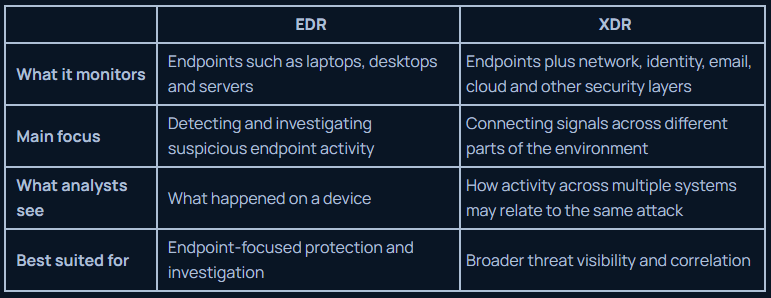
EDR (Endpoint Detection and Response) is a core layer of endpoint security. It monitors laptops, desktops, and servers, helping security teams detect threats, investigate suspicious activity, and contain compromised devices.
XDR (Extended Detection and Response) connects that endpoint activity with security signals from supported network, identity, email, and cloud systems.
For a quick reference, here’s the simplest way to look at the difference:
How Would EDR and XDR Investigate the Same Attack?
EDR detects suspicious activity on endpoints. XDR can connect endpoint alerts with email, identity, and cloud activity, provided those data sources are integrated.
Consider a financial services company operating across Dubai and Abu Dhabi. It uses Microsoft 365 for email and files, and every laptop runs EDR.
Now, let’s say an employee receives a fake document-signing request and enters their password and MFA code on a lookalike Microsoft login page. The attacker captures the signed-in session and opens the mailbox from outside the UAE. They set an inbox rule to hide payment-related emails and download finance files from SharePoint. Finally, they use the compromised mailbox to send a “secure invoice viewer” to a colleague, which installs a remote access tool on the colleague’s laptop.
Now let’s see how the alert travel through EDR:
EDR raises an alert when the remote access tool runs on the colleague’s laptop. You investigate the device, isolates it, and removes the malware.
But the earlier account compromise, hidden inbox rule, and SharePoint downloads sit outside EDR’s endpoint visibility. Unless the analyst checks Microsoft 365 logs separately, those activities may remain unnoticed.
But, for XDR, with email, identity, cloud, and endpoint data connected, it can correlate suspicious activity involving the compromised account.
Instead of investigating the laptop alert in isolation, the analyst can examine the preceding sign-in, inbox rule, and SharePoint activity as part of the same incident.
The response can then address the wider compromise: isolate the laptop, revoke the stolen session, remove the inbox rule, and contain the phishing campaign using supported response actions.
In my view, the bigger risk with EDR alone isn’t missing the attack. It’s closing the ticket believing the attack is over. In this example, EDR did its job and caught the malware. But by then, the attacker had already got in, stayed in, and taken what they came for, all without touching a laptop.
That’s the gap XDR is designed to address by connecting what happened on the endpoint with what was happening around it.
When Should a Business Choose XDR Over EDR?
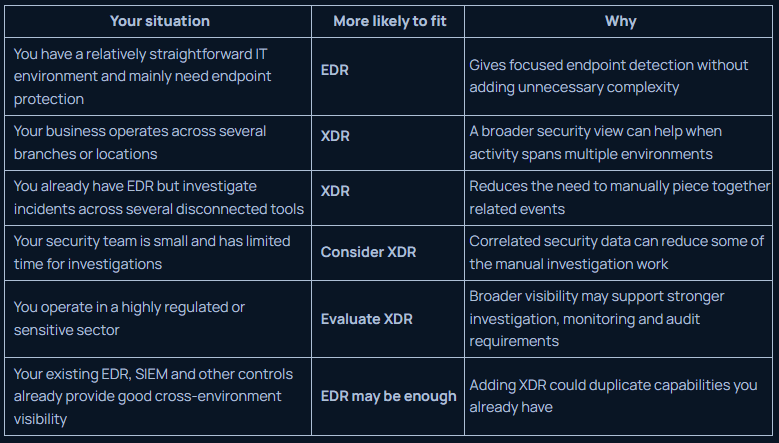
A business or their IT team should go for a XDR over EDR when their incidents regularly cross from endpoints into accounts, email, networks, or cloud applications, and their current tools can’t connect them. Broader visibility on its own doesn’t mean that they’d need XDR.
For a UAE business, the whole exercise should start with the complexity of the environment, the risk of an incident, and the capacity of the security team – not with which product has the longer feature list.
Here’s an easy way to know when and if your team should consider an XDR over your current EDR:
EDR
XDR
XDR
The industry matters, but it shouldn’t determine the answer by itself.
A financial services company handling sensitive transactions may place greater value on seeing how an identity-related event connects with endpoint or application activity. A healthcare provider operating across multiple facilities may have different visibility requirements from a real estate company with a smaller, mostly cloud-based environment.
And this is why I think XDR is worth the investment when it closes a security gap your current tools cannot address.
Also, don’t get fixated on the XDR “label” just because a known brand is seemingly offering one for a slightly higher price than your current EDR. Evaluate what the XDR really offers, what additional value you get out of it, and what your current EDR can’t do.
We’ve had a client who switched to a new XDR only because it was a known brand XDR and just a bit more expensive than their existing EDR, but essentially their EDR provided the same functionality as the new XDR promised.
What Should UAE Businesses Check Before Choosing XDR?
Even if an XDR platform meets your technical requirements, it may not be the right investment for your current environment.
1. Are You Paying for Capabilities You Already Have?
Review your EDR, firewalls, identity security, email security, and SIEM tools. Some may already provide threat correlation and automated response. Check what an additional XDR platform would provide before paying for overlapping capabilities.
2. Where Do Your Investigations Slow Down?
Look at a recent security incident. Did analysts spend time collecting logs from different branches? Were account activity, endpoint events, and firewall alerts investigated separately?
These gaps help establish whether XDR can improve investigations. Ask the vendor to demonstrate how its platform would handle a similar incident.
3. Who Will Respond to the Alerts?
An XDR platform doesn’t automatically provide continuous security monitoring. Your business still needs analysts to validate threats, approve containment actions, and manage escalation.
If your internal team cannot provide that coverage, managed detection and response may be more relevant than purchasing another standalone platform.
4. What Will Deployment and Operations Cost?
Include licensing, integration work, log ingestion and retention, training, and ongoing monitoring. For businesses with multiple branches, check the cost of connecting and maintaining each location. The full cost matters more than the software price alone.
I think these checks are necessary before you purchase another security platform. If they confirm the need for XDR, here’s what to look for in the platform itself.
What to Look for in an XDR Solution in the UAE
Let’s say you’ve established the need for XDR. Then you need to check these required capabilities in the platform you choose.
1. Integration With Your Existing Security Tools
Your business may already have endpoint security, firewalls across branches, Microsoft 365, and cloud security controls.
Check whether the XDR platform supports the exact products and versions you’re using.
Also check what each integration can do. Does it collect detailed security events or only forward alerts? Can analysts investigate activity across the connected systems?
Five tools connected to one dashboard don’t necessarily provide one connected investigation.
2. Detection and Investigation Capabilities
Ask the vendor to demonstrate an attack involving a suspicious account login, endpoint activity, and an unusual network connection.
Can the platform reconstruct the sequence of events? Can analysts identify which accounts and systems were affected?
For UAE businesses with multiple offices, the demonstration should include the types of endpoint, firewall, and identity data used across those locations.
Don’t settle for a demonstration showing how many alerts the dashboard can display.
3. Response and Automation Controls
Check what happens after an incident is confirmed. Can the platform isolate a compromised laptop, disable an account, or block a malicious connection? Which actions require approval?
For an Abu Dhabi healthcare provider, isolating an administrative device is different from interrupting a system involved in clinical operations.
Response controls should match the risk of disrupting business-critical systems.
4. UAE Data Handling and Deployment Requirements
Establish where security telemetry is stored, processed, and accessed. This is important for organizations handling sensitive financial, healthcare, or customer information.
For banks covered by the CBUAE Outsourcing Standards, relevant considerations include access management, audit trails, data protection, and incident handling when outsourcing services.
Abu Dhabi healthcare organizations subject to ADHICS V2 must also consider requirements for monitoring, logging, and incident management. Under Article 13 of Federal Law No. 2 of 2019, health data linked to services provided in the UAE generally cannot be stored or processed outside the country without health authority approval.
So, ask vendors about hosting arrangements, remote access, subcontractors, retention periods, and data deletion when the contract ends.
Not every UAE business has the same data-residency requirements. Local hosting alone doesn’t establish compliance.
Will An XDR Work With Your Existing Security Tools?
DC Technologies can review your current environment, integration requirements, and monitoring needs before recommending additional security technology.
When Should UAE Businesses Consider Xyra XDR?
If your existing security tools detect threats but leave analysts connecting incidents manually, Xyra XDR is a good option worth evaluating.
Consider three situations:
- Your endpoint and network alerts are disconnected. Xyra correlates activity across these sources to help analysts establish whether separate alerts belong to the same attack.
- Investigations take too much manual work. Xyra’s Security GPT supports incident investigation and attack-chain reconstruction, helping analysts examine related security events.
- Your response process involves multiple tools. Xyra’s built-in SOAR supports response playbooks, allowing teams to coordinate supported containment actions.
For UAE businesses, DC Technologies also offers Xyra with UAE-resident security telemetry and locally managed security operations.
However, if your existing EDR, SIEM, and security tools already provide effective incident correlation and response, adding Xyra may duplicate capabilities.
At the end, the deciding factor will always be whether Xyra improves investigations and response in your existing environment, not how many features it offers.
XDR Deployment and Managed Response in the UAE
DC Technologies helps UAE businesses assess their existing security environment, integrate security tools, and manage ongoing detection and response.
Our approach depends on what your business already has.
If your tools cannot connect relevant security events: We provide system integration services covering endpoints, firewalls, networks, and other security infrastructure. Its team can assess the environment, recommend the required solutions, and handle deployment and integration.
If your team lacks continuous monitoring: We provide 24/7 MDR and SOC services, with in-house analysts handling alert triage, investigation, and response.
If your existing tools provide the required detection capabilities: Our platform-agnostic MDR service can monitor and manage the security tools you already own. We can also help assess your current environment and determine whether XDR is the right next step for you.
If XDR is the better fit, then Xyra XDR offered by DC Technologies is a valuable option. It combines cross-system threat correlation with our UAE-based deployment and managed security offering.
FAQs
What is Managed XDR?
Managed XDR is an XDR platform run by a provider’s analysts, who monitor alerts, investigate incidents, and take containment actions for you. It suits businesses that need cross-system visibility but don’t have a 24/7 security team. In the UAE, also check where the provider stores your telemetry and who can access it.
What is Open XDR?
Open XDR collects and correlates data from the security tools you already own, across different vendors. Native XDR relies mainly on one vendor’s endpoint, email, and network products. Open XDR protects your existing investments, while native XDR usually offers deeper integration. Many platforms now combine both approaches.
Can XDR replace EDR?
Not always. Some XDR platforms include native endpoint protection and detection capabilities. Others integrate with existing EDR products. Check the platform architecture and licensing before replacing your endpoint tools.
How does XDR actually work to protect your endpoints?
XDR combines endpoint telemetry with signals from identity, email, network and cloud systems. This gives teams more context around endpoint alerts and helps determine whether they are part of a wider attack.
Do you need XDR if you already have Microsoft Defender?
You may already own XDR capabilities, so check your Microsoft license first. Microsoft 365 E5 includes Microsoft Defender XDR across endpoint, email, identity, and cloud apps. Business Premium includes Defender for Business, which focuses on endpoints. If you own Defender XDR but nobody monitors it, the gap is monitoring, not another platform.
Do UAE businesses need locally hosted XDR?
Not every business is subject to the same data-residency requirements. Healthcare providers face the strictest rules on where health data can be stored. Check out the applicable sector regulations, contracts, and data-handling requirements before choosing a deployment model.
What should UAE banks check when evaluating XDR?
Banks should establish whether the platform supports their monitoring, access-control, audit-trail, and incident-response requirements. If the arrangement involves outsourcing, the applicable CBUAE Outsourcing Standards must also be considered.
Is XDR necessary for a small business in the UAE?
XDR is not necessary for every small business in the UAE. EDR may be sufficient for a business with straightforward endpoint security requirements. XDR becomes relevant when attacks involve several disconnected systems, such as Microsoft 365, cloud applications, and branch firewalls, and investigations require broader visibility.
Can XDR replace SIEM?
XDR can replace a SIEM for many SMBs, because it covers the detection and response a SIEM was often bought for. Keep your SIEM if you need long-term log retention for audits, broad compliance reporting, or correlation of data that XDR connectors don’t support.
What is the difference between EDR, MDR, and XDR?
EDR and XDR are technologies, while MDR is a service. EDR watches endpoints, XDR correlates endpoints with identity, email, network, and cloud activity, and MDR is a team that monitors either technology 24/7 and responds for you. Without a round-the-clock SOC, XDR alone leaves alerts waiting until morning, so pair it with MDR or buy it as a managed service.