
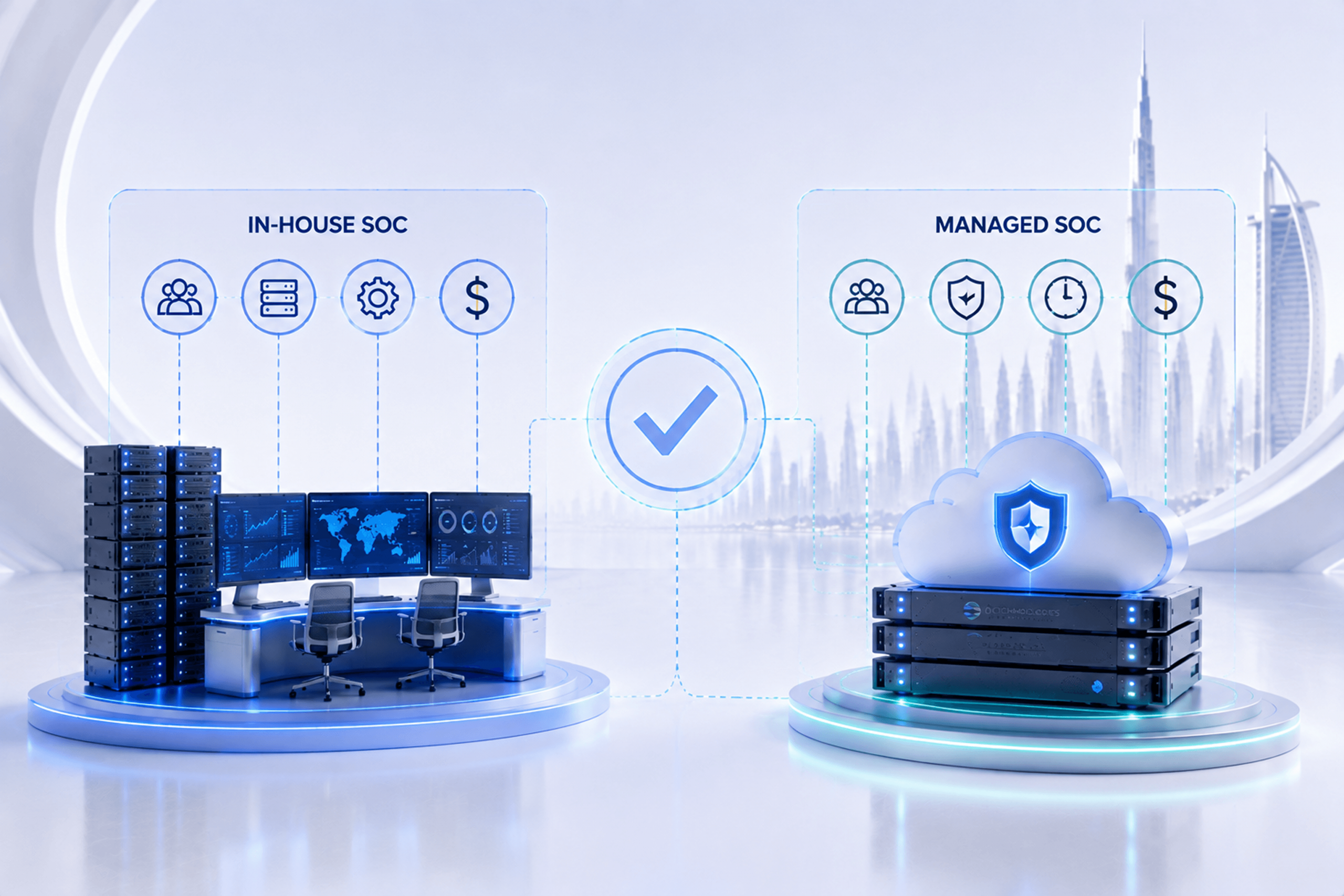
If you have the people, budget, and security maturity to operate 24×7 monitoring internally, an in-house security operations center gives you greater control.
For most mid-market businesses in the UAE without that capacity, SOC as a Service is the more practical option because you get continuous monitoring, security expertise, and established processes without building the entire operation yourself.
The real decision comes down to what you’re prepared to own.
This guide compares both models by cost, control, coverage, expertise, and operational responsibility to help you decide which fits your business.
TL; DR
- In-house means more control: You own the people, tools, coverage, and operations.
- Managed means less overhead: Get 24×7 monitoring without building the full SOC.
- SOC costs more than tools: Staffing, training, management, and maintenance add up.
- The right model depends on your needs:> Consider your budget, resources, maturity, and coverage requirements.
- DC Technologies provides 24×7 SOC support: L1/L2 analysts monitor and investigate threats without an in-house SOC build.
What Does It Cost to Build an In-House SOC?
An in-house SOC needs three things working together: people, technology, and operations. Missing any one of them creates gaps in coverage.
For organizations building a private SOC, that means owning the entire security operation rather than simply purchasing the required tools
People
24×7 coverage takes more than a few analysts. You need enough L1/L2/L3 staff to cover shifts, weekends, leave, investigations, threat hunting, and incident response.
Then there’s hiring, training, retention, and replacing people when they leave.
For UAE businesses competing for experienced cybersecurity professionals, maintaining this level of staffing can become a significant recurring cost.
Technology
Your team also needs the security stack to detect and investigate threats:
- SIEM: Collects and correlates security events.
- EDR/XDR: Detects suspicious activity across endpoints and systems.
- Threat intelligence: Adds context to indicators and attacks.
- SOAR: Automates repetitive investigation and response tasks.
Buying the tools is only the start. Someone still has to integrate them, tune detections, reduce false positives, and keep them working as the environment changes.
Operations
The SOC also needs clear escalation paths, incident response playbooks, reporting, and regular testing.
So the real question isn’t “Can we afford the tools?”
It’s “Can we continuously fund and operate the people, technology, and processes needed to make those tools useful?”
For a UAE mid-market business, that distinction matters. The cost of an in-house SOC is not the cost of the security software alone. It includes salaries, shift coverage, recruitment, training, management, technology, maintenance, and the operational overhead required to keep the SOC running 24×7.
The next question is what changes when you stop building all of this yourself and use a managed SOC instead.
What Do You Get With a Managed SOC?
With SOC as a Service, you are buying access to an existing security operation without having to build the entire team, technology stack, and 24×7 coverage internally.
What you get
- 24×7 monitoring: Security events are monitored around the clock, including nights and weekends.
- Security analysts: You get access to L1/L2 expertise without hiring an entire SOC team.
- Threat detection and investigation: Alerts are investigated and correlated instead of simply forwarded to your IT team.
- Threat hunting: Analysts actively look for suspicious activity that automated alerts may miss.
- Incident response: Confirmed threats can be escalated and handled through defined response processes.
- Security tooling: The provider manages or works across the required security platforms, reducing the burden of running the entire stack internally.
For UAE businesses, this can be particularly useful when security requirements are increasing but the internal team and budget have not grown at the same rate.
What you give up
The trade-off is control.
You have less control over who performs the day-to-day monitoring, how the SOC operates internally, and which processes the provider uses. You also become dependent on the provider’s response quality, communication, and ability to understand your environment.
That makes provider selection important. A managed SOC should extend your security capability, not become another black box your IT team has to manage.
The trade-off is straightforward, and the right choice depends on what your business can realistically support.
In-House vs Managed SOC: Which Model Fits Your Business?
There is no single answer for every organization. Use the factors below to see which model fits your current resources, risk, and security requirements.
Your IT team is already overloaded
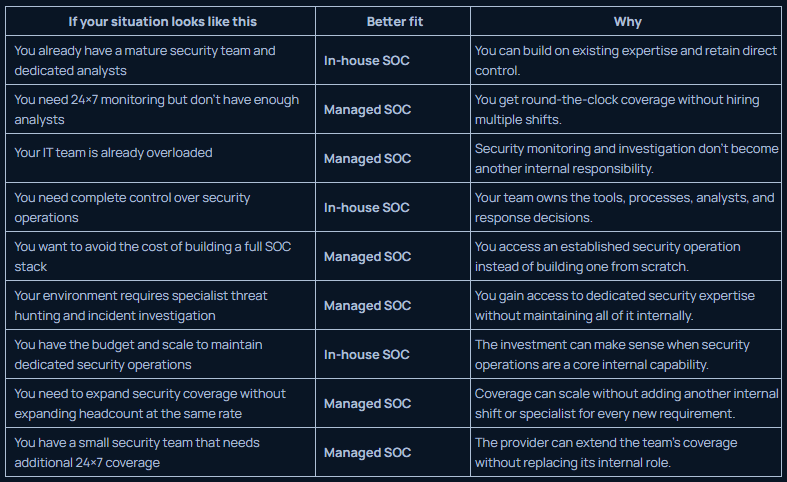
The build-vs-buy decision ultimately comes down to one question: which model gives your business the security coverage it needs without creating an operational burden it cannot sustain?
Compliance and Security Requirements: Does It Change the Decision?
Yes. In the UAE, regulated sectors like financial services, healthcare, and government may have requirements for security controls, monitoring, logging, incident response, and data protection.
But compliance is not the only reason to invest in security monitoring.
A manufacturing company, real estate business, professional services firm, or other mid-market organisation may not face the same regulatory requirements, but it can still face ransomware, credential theft, phishing, and other attacks that require rapid detection and investigation.
What should you consider?
- Regulatory requirements: Check if your industry or customers require specific security controls, monitoring, or incident response.
- Data sensitivity: The more sensitive your data (customer, financial, employee), the more important continuous protection and visibility become.
- Incident response requirements: Consider how fast you need to detect, investigate, and respond to security incidents.
- Audit and reporting: Some organizations need clear records of security events and responses for audits or compliance.
- Data handling: If using a managed SOC, know where your data is stored, who can access it, and how it is protected.
Conclusion
For many UAE SMBs, security is already competing with infrastructure, IT support, and other priorities for the same people and budget. A managed security operations center can take that operational weight off the internal team while keeping security decisions with the business.
DC Technologies provides SOC as a Service with 24×7 monitoring and L1/L2 analysts to give organizations dedicated security coverage without building the entire operation internally.
FAQs
What does a security operations center actually do?
A security operations center (SOC) brings security monitoring, investigation, threat detection, and incident response into one continuous operation.
What is a managed SOC and do I actually need one?
A managed SOC is an outsourced security operation that monitors and responds to threats for your business. It is useful when security requirements have outgrown what your existing IT setup can handle.
Do small businesses really need a SOC?
Not every small business needs a dedicated internal SOC. A managed security operations center can provide access to 24×7 monitoring and security expertise without the cost of building an entire SOC team.
Do I really need a SOC as a Service or just monitoring?
Monitoring tells you that something happened; a SOC adds investigation and response around those alerts. The difference matters when an alert needs to be understood and acted on quickly.
Managed SOC vs. in-house security: which is better for my company?
Neither model is universally better. The right choice depends on how much security responsibility your business wants to own internally and the capabilities already available to your team.