
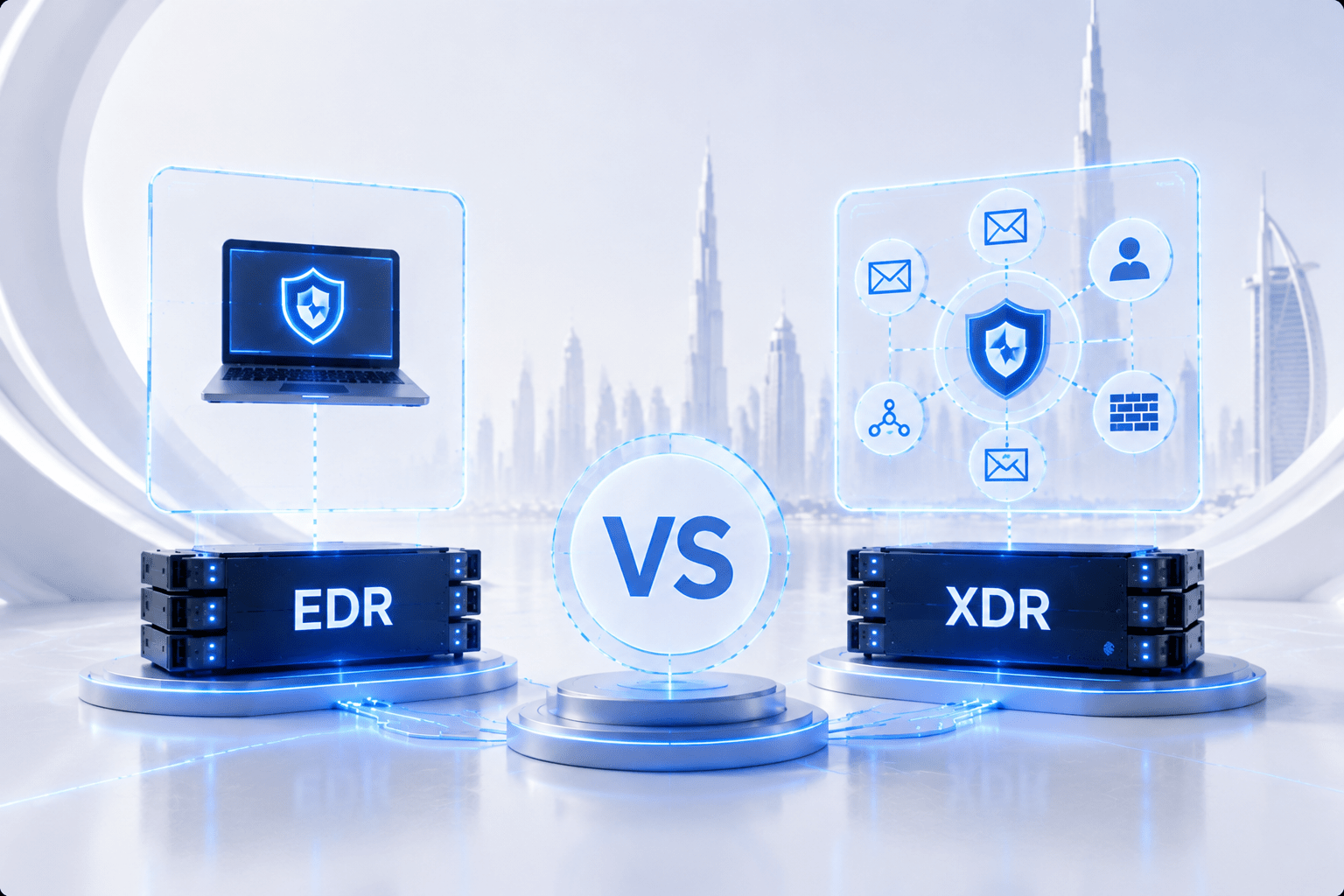
If you already have EDR, do you really need XDR? EDR vs XDR comes down to how much of an attack you can actually see.
Your endpoint might flag suspicious activity, but what happened before that? Was an employee’s account compromised? Did a phishing email open the door? Did the attacker move through a cloud application or another system?
For UAE businesses across financial services, healthcare, real estate and other sectors, these incidents rarely stay neatly contained to one device.
By the end of this article, you’ll know when EDR is enough, when XDR adds real value, and what to consider before taking on the extra cost and complexity.
TL; DR
- EDR focuses on endpoints: It gives deep visibility into laptops, desktops and servers.
- XDR connects the dots: It correlates activity across endpoints, identity, email, network and cloud.
- EDR may be enough: If your environment is straightforward and your existing tools provide adequate visibility, you may not need XDR.
- XDR makes sense when visibility is fragmented: It can help when attacks cross multiple systems and analysts are manually piecing incidents together.
- Choose based on your environment: For UAE businesses, consider your infrastructure, security requirements, team capacity and existing security stack before adding XDR.
- Xyra as an option: Xyra XDR correlates endpoint, network, email and cloud telemetry, with DC Technologies providing local UAE deployment and security expertise.
What's the Actual Difference Between EDR and XDR?
For a quick reference, here’s the simplest way to look at the difference:
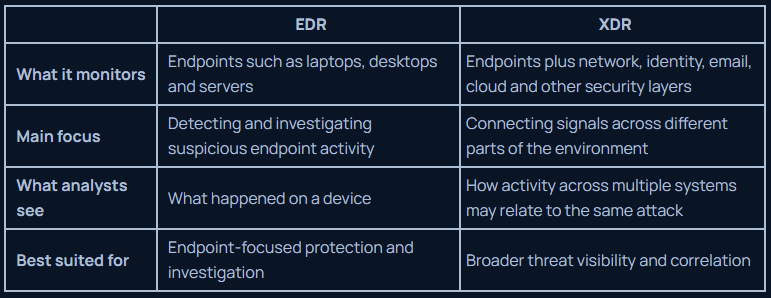
Think of EDR as watching one room in a building. XDR connects the cameras across the building. If something suspicious happens in one room, EDR can investigate it there. XDR can help show whether someone entered through another room first, moved through the building, and triggered activity elsewhere.
And this is where relying on EDR alone can start to leave some uncomfortable blind spots.
Is EDR Enough for Your Business?
An attacker doesn’t care which security tool you’re using. They move wherever they can.
They might start with a phishing email, steal an employee’s credentials, log into a cloud application, and only later reach an endpoint. By the time EDR flags something suspicious, the attack may already have a history.
That creates three common gaps.
The attack may start somewhere EDR can't see
A compromised Microsoft 365 account doesn’t necessarily look like an infected laptop. An attacker using stolen credentials can access email, cloud applications or other business systems without dropping malware onto the endpoint.
EDR can tell you what happened on the device. It may not tell you what happened to the account before that.
One alert can hide a much bigger incident
Imagine a finance employee clicks a phishing link.
A few hours later:
- Their account logs in from an unusual location.
- A cloud application is accessed.
- The employee’s laptop starts making an unusual connection.
- Another internal system receives unexpected access.
If those events sit in separate security tools, your analyst has to piece the story together manually.
The problem isn’t a lack of alerts. It’s the missing context between them.
Distributed businesses have more places for an attacker to move
This is particularly relevant to UAE businesses with branch offices, remote staff, BYOD and cloud-based applications.
A real estate company may have brokers working from different locations. A healthcare provider may have staff accessing clinical systems across sites. A financial services business may have employees moving between offices and cloud applications throughout the day.
The more distributed the environment, the harder it becomes to understand an attack from endpoint data alone.
That’s the gap XDR is designed to address: connecting what happened on the endpoint with what was happening around it.
Does Your Business Need an XDR?
Having a wider view doesn’t automatically mean you need XDR. The question is whether that wider view solves a problem your current security setup can’t.
For example, consider a business where the security team already has EDR, email security, a firewall and identity controls. The tools are doing their jobs. Alerts are coming in.
But an analyst investigating a suspicious login has to jump between four different consoles to work out:
- Was the account compromised?
- Did the user receive a phishing email?
- Did the endpoint show any related activity?
- Did the account access anything unusual afterwards?
XDR makes more sense when:
Your attacks don’t stay on one endpoint.
If incidents regularly involve identity, email, cloud applications or network activity, endpoint-only visibility can leave gaps in the investigation.
Your security tools don’t talk to each other.
Having five security products doesn’t automatically give you five times the visibility. If each produces isolated alerts, your analysts still have to connect them manually.
Your team is spending too much time investigating noise.
Correlation can help analysts see related events together instead of treating every alert as a separate incident.
You need broader visibility but don’t have the resources to build it yourself.
This is particularly relevant to mid-market businesses that have security tools in place but don’t have a large internal SOC to operate them around the clock.
But XDR isn’t automatically the answer
If your environment is relatively straightforward, your EDR already provides the visibility you need, and your existing SIEM or SOC handles cross-platform correlation effectively, adding another layer may not solve anything.
Once you understand what XDR adds, the EDR vs XDR decision becomes less about features and more about what your business actually needs to secure.
EDR vs XDR: Which One Makes Sense for Your Business?
For a UAE business, start with the complexity of the environment, the risk of an incident, and the capacity of the security team – not with which product has the longer feature list.
EDR
XDR
XDR
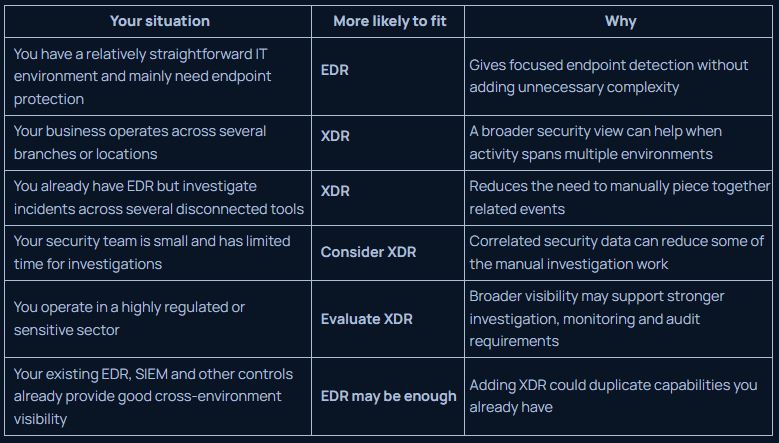
The industry matters, but it shouldn’t determine the answer by itself.
A financial services company handling sensitive transactions may place greater value on seeing how an identity-related event connects with endpoint or application activity. A healthcare provider operating across multiple facilities may have different visibility requirements from a real estate company with a smaller, mostly cloud-based environment.
And this is why “XDR is better than EDR” is the wrong conclusion.
Looking for an XDR for Your UAE Business?
If you’ve decided that broader detection and response makes sense, the next question is what the XDR platform needs to deliver.
At DC Technologies, we start by assessing your existing infrastructure, security tools, and operational requirements. We then recommend a solution that best fits your environment.
Xyra XDR, offered by DC Technologies, brings security signals together to help businesses detect, investigate and respond to threats across their environment.
For UAE mid-market businesses, the important consideration is whether the solution can fit your existing security stack, provide useful visibility, and support the way your team actually operates.
We can help assess your current environment and determine whether XDR is the right next step before recommending Xyra.
FAQs
What is EDR and do I really need it for my small business?
How does XDR actually work to protect your endpoints?
XDR combines endpoint telemetry with signals from identity, email, network and cloud systems. This gives teams more context around endpoint alerts and helps determine whether they are part of a wider attack.
EDR vs XDR: Which one do I actually need?
It depends on your environment. EDR may be enough if endpoint protection is your main concern. XDR makes more sense when you need to connect security signals across endpoints, identity, email, network or cloud.
Should we switch from EDR to XDR?
Not necessarily. If your EDR provides the visibility your team needs, switching may add unnecessary cost and complexity. Consider XDR when important activity sits outside endpoint data or your team spends too much time connecting alerts.
Can XDR replace EDR completely?
No. XDR builds on endpoint and other security data rather than replacing endpoint protection. EDR provides detailed endpoint visibility, while XDR correlates it with signals from other parts of your environment.