
A business with 500 endpoints may already have reliable cybersecurity products deployed across its environment.
Endpoint protection on employee devices. Firewalls controlling network traffic. Microsoft 365 security policies protecting employee accounts. Perhaps a SIEM platform collecting logs from critical systems.
But keeping these controls effective requires continuous operational attention.
This is where a Managed Security Service Provider (MSSP) becomes relevant.
The UAE has several established cybersecurity providers, but their managed services differ considerably.
Some offer bundled endpoint and email protection. Others specialise in SOC operations, security control administration, threat detection or compliance-related security management.
For businesses managing approximately 200–1,000 endpoints, choosing the right provider means a lot as the security needs have become quite demanding.
A bigger problem with going for a larger more established MSSP is that they might not have the right delivery model aligned for the processes of SMBs and the kind of problems in their environments that deserve more attention.
This article examines seven managed security service providers serving the UAE, focusing on their capabilities, advantages, service models and important considerations that are specifically relevant for SMBs.
How We Selected These Managed Security Service Providers
This list is compiled by reviewing publicly available service information from cybersecurity companies serving the UAE market.
Our selection focuses on providers which could reasonably address the requirements of businesses managing approximately 200 – 1,000 endpoints.
We considered five factors:
- UAE market presence: Local operations, regional service delivery or documented managed security availability for UAE customers.
- Managed security capabilities: Ongoing monitoring, security control administration, incident investigation, threat response and related operational services.
- Suitability for growing businesses: Service packages, commercial flexibility and delivery models that may accommodate smaller IT and security teams.
- Technology compatibility: Support for existing security investments, third-party integrations, and different security operating models.
- Service transparency: Publicly documented information about monitoring hours, response responsibilities, pricing, service tiers and specialist capabilities.
Note: This is not a ranking from best to worst. Just seven providers which we thought fit the needs of SMBs really well.
The comparison is based on information available in October 2026.
Published service descriptions are treated as statements of provider capability, rather than independently verified performance. Where contractual details are unavailable, we identify what buyers should confirm directly.
Quick Comparison: 7 Managed Security Services Providers in UAE
Provider
Key capabilities
Particularly relevant for
- CYB3R
SME security packages, MDR, managed SOC, endpoint and email security
Businesses looking for bundled security subscriptions and tiered SOC options
- DC Technologies
Managed security operations, security control configuration, MDR, SOCaaS and compliance-aligned controls
UAE SMBs seeking ongoing management of existing security investments
- EnCyb
Managed endpoint security, cloud security, MDR, SOCaaS and vulnerability management
Growing businesses seeking security and cloud operations under related managed services
- eShield IT Services
Managed SOC, vulnerability scanning, compliance reporting and incident response
Businesses wanting published endpoint-based SOC packages and UAE-hosted monitoring
- iConnect IT Business Solutions
Managed firewall, endpoint, identity, SIEM, cloud security and 24/7 SOC
Businesses requiring hands-on administration of multiple security controls
- Wattlecorp
Managed security, SOC deployment, SIEM, vulnerability management and on-site operations
Organisations seeking customised security operations and assessment services
- DTS Solution
HAWKEYE managed SOC, detection engineering, threat hunting and specialist security services
Technically complex mid-market environments requiring advanced security engineering
1. CYB3R
Best considered for: UAE SMEs seeking packaged cybersecurity services with defined service tiers and options for more comprehensive managed security operations.
CYB3R provides managed cybersecurity services covering endpoint protection, email security, identity management, vulnerability management, managed detection and response, and SOC operations.
The company explicitly targets small and medium-sized businesses alongside its other customers.
One of its distinguishing characteristics is a published SME security package structure, giving buyers an initial understanding of the protections available and how the service expands.
Where does CYB3R stand out?
Published per-user security packages
CYB3R advertises three SME packages:
Package
Advertised price
Selected capabilities
Security Basics
AED 45/user/month
Endpoint protection and EDR, MFA, browser security, email security
Security Essentials
AED 75/user/month
Additional Microsoft 365/Google Workspace protection, password management and an annual security assessment
Security Plus
AED 115/user/month
Additional awareness training, leaked credential monitoring, backup and encryption, and 24/7 MDR
These are provider-advertised prices. Exact inclusions, minimum commitments and licensing should be confirmed.
However, buyers should distinguish between the number of employees and the number of endpoints.
A business with 350 employees may operate 500 laptops and desktops, 30 servers and several shared devices. A per-user subscription may not account for every asset requiring security management.
Different levels of SOC coverage
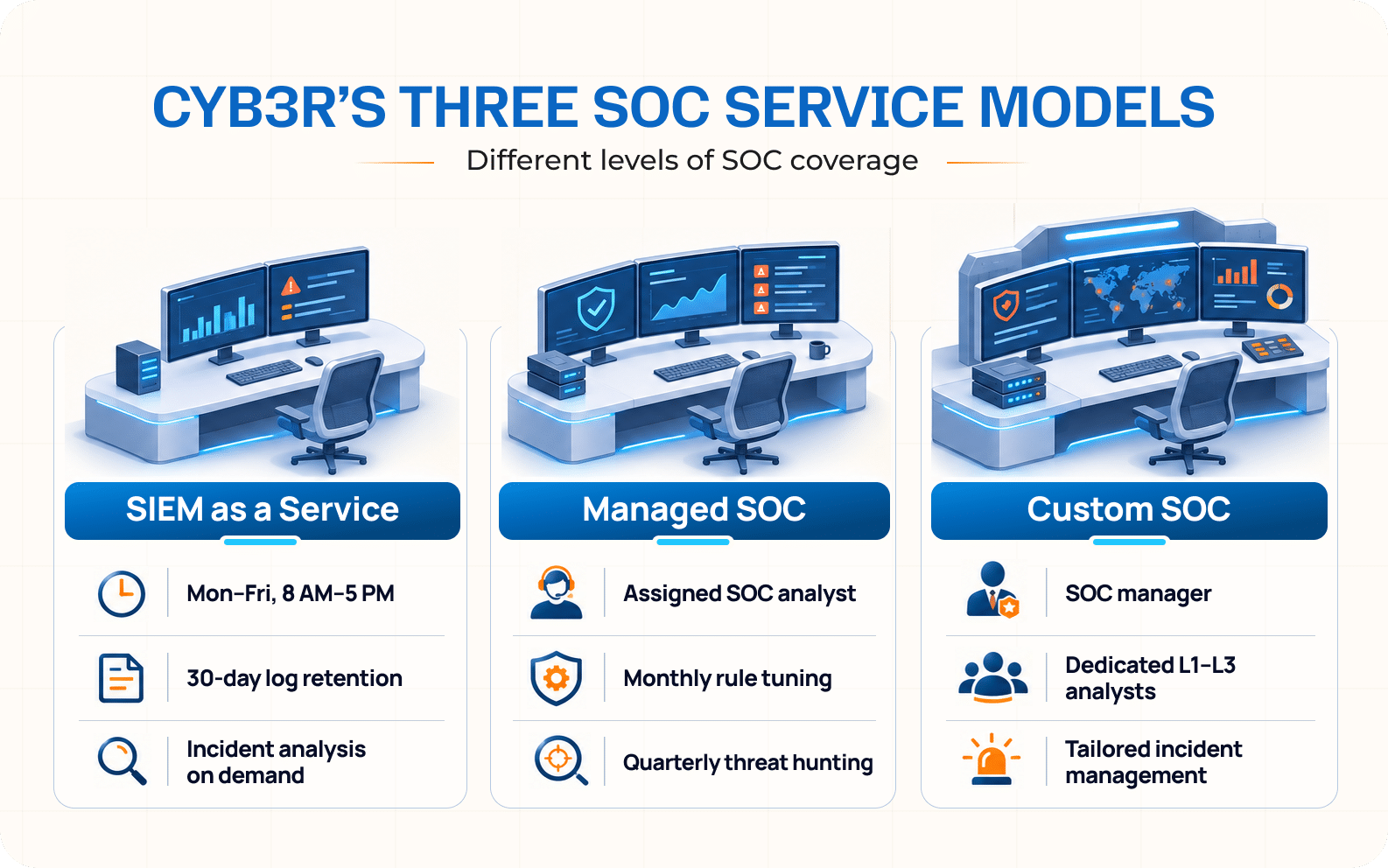
CYB3R also publishes three SOC models.
Its SIEM as a Service option is based on Elastic and includes log collection, correlation, dashboards and reporting. Its advertised monitoring schedule is Monday to Friday, 8 AM to 5 PM, with 30 days of log retention.
Incident analysis and management under that tier are available separately on demand.
The fuller CYB3R SOC offering includes a wider range of log-source integrations, a dedicated assigned SOC analyst, monthly detection-rule tuning, SOAR capabilities, high-severity incident investigation and quarterly threat hunting.
A custom SOC option adds tailored infrastructure, specialist resources, a SOC manager and dedicated L1–L3 analysts.
These differences are significant. Businesses seeking around-the-clock security monitoring should evaluate the fully managed or customized offerings rather than assume that every SIEM service includes continuous analyst coverage.
What should buyers consider?
Pros
Cons / Trade-offs
- Published security packages at AED 45, AED 75 and AED 115 per user/month provide a clear starting point for budgeting.
Pricing is per user, not per monitored endpoint. Server coverage, additional log sources and other requirements need to be accounted for separately.
- Offers SIEM as a Service, fully managed SOC and custom SOC arrangements.
Its entry-level SIEM service monitors Monday–Friday, 8 AM–5 PM. Incident analysis and management are separate on-demand services at that tier.
- Custom SOC includes a dedicated SOC manager, L1–L3 analysts, continuous threat hunting and tailored incident management.
The standard managed SOC instead specifies quarterly threat hunting and vulnerability scanning. Dedicated resources belong to its custom offering.
- Supports EDR, firewalls, network detection, and other log sources.
Published log retention is 30 days for SIEM as a Service and up to 45 days for the standard managed SOC. Longer retention may require a custom agreement.
Our assessment
CYB3R is particularly relevant for UAE SMEs looking for a structured entry into managed cybersecurity.
Its published prices and differentiated SOC models give businesses useful information before requesting a proposal.
For organizations managing 200–1,000 endpoints, the main consideration is choosing the correct combination of endpoint protection, MDR and wider security operations coverage.
Website: cyb3r.ae
2. DC Technologies
Best considered for: UAE SMBs and mid-sized businesses seeking ongoing security monitoring, security control management and incident response using compatible technologies already deployed in their environment.
DC Technologies is a Dubai-based managed infrastructure and cybersecurity services provider focused on UAE businesses.
The company has operated in the UAE market for more than 13 years, with experience in system integration, cybersecurity technologies and infrastructure services.
Its managed cybersecurity offerings include:
- Managed Detection and Response (MDR)
- SOC as a Service (SOCaaS)
- Security control configuration and ongoing technical management
- Vulnerability assessment and penetration testing
- XDR solutions
- Supporting infrastructure, backup and disaster recovery services
Where does DC Technologies stand out?
Managing existing security investments
Many growing businesses have gradually accumulated security technologies from different vendors.
An endpoint solution may have been deployed during one IT project, while firewalls, email protection, and cloud security controls were introduced separately.
Over time, this creates a lot of SecOps challenges.
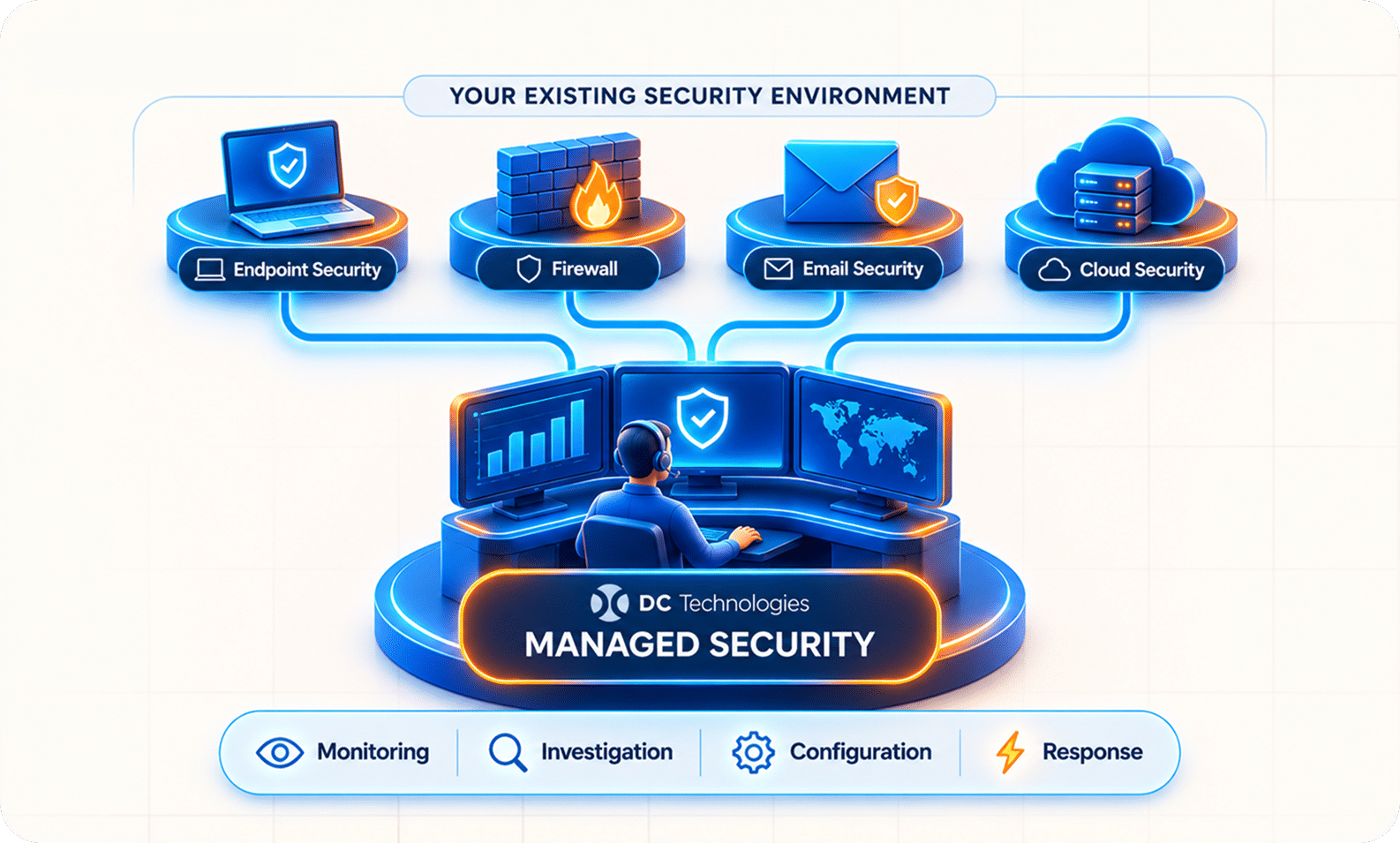
DC Technologies’ managed security model focuses on the customer’s existing environment.
Their team works with compatible security technologies already deployed, monitors their operation and manages the agreed security functions.
This can be particularly relevant for a business that has invested in security products but lacks dedicated personnel to maintain their configurations and investigate alerts.
DC Technologies’ engineers can make configuration changes to supported security products so that they operate as intended and align with the organization’s defined security policies.
Security control management alongside monitoring
An important distinction between managed security services and basic security monitoring is the provider’s responsibility for maintaining the controls themselves.
A monitoring provider may receive alerts from a security product and escalate suspicious events.
A managed security engagement can additionally cover appropriate configuration changes, policy adjustments, and other administrative activities.
DC Technologies supports both security monitoring and technical security control management.
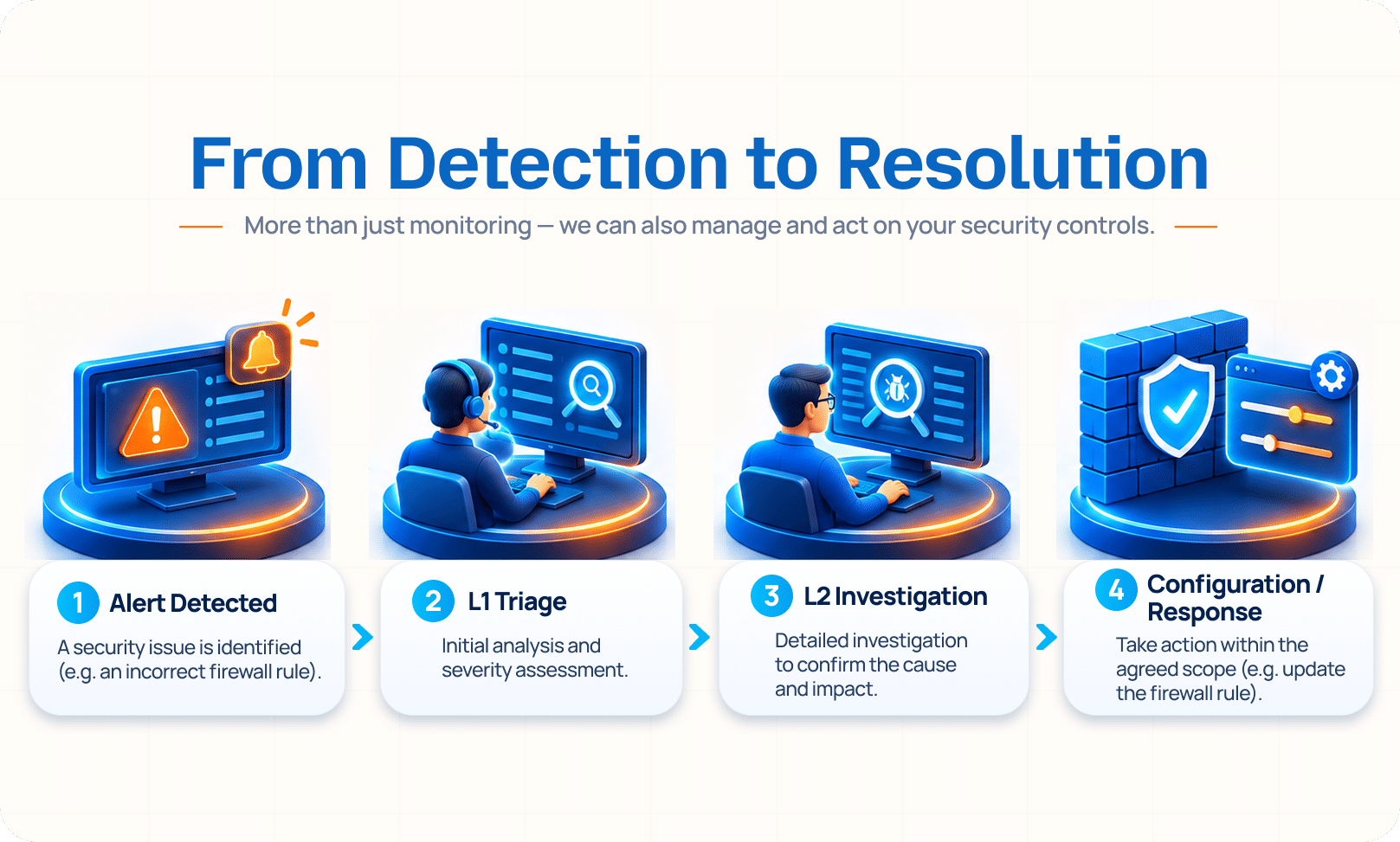
This is relevant when an alert identifies a weakness that requires a configuration change, such as adjusting a security policy or improving detection settings.
Compliance-aware security management
DC Technologies also brings knowledge of cybersecurity compliance requirements into its security operations.
For businesses working under regulatory or contractual obligations, this can help ensure technical security controls are configured and maintained in line with applicable policies.
DC Technologies can help customers implement and maintain relevant technical controls within its agreed service scope.
24/7 security operations and incident response
DC Technologies provides managed monitoring, alert triage, threat investigation and incident response through its MDR and SOCaaS services.
Its published service model emphasises:
- 24/7 security monitoring
- In-house security operations
- Direct access to technical personnel
- Alert investigation and escalation
- Response activities within agreed permissions
- Integration with compatible existing security technologies
The company’s SOC service describes L1 analysts handling initial alert triage and L2 engineers investigating security incidents.
It can also scope fully managed operations involving L1–L3 resources, with staffing arrangements and specialist responsibilities defined by the engagement.
The combination of security operations and infrastructure services may also help when incidents involve both cybersecurity and systems administration.
What should buyers consider?
Pros
Cons / Trade-offs
- Designed to work with compatible security tools already deployed, avoiding unnecessary replacement.
Compatibility depends on supported integrations, product editions, and telemetry access. Not every legacy product or feature can be assumed to be supported.
- Goes beyond alert monitoring. The team also makes configuration changes, tunes products and aligns security controls with established policies.
The contract must distinguish continuous administration from installation, periodic maintenance, and project-based changes.
- Provides 24/7 in-house MDR and SOC operations, with direct technical engagement and an L1–L3 fully managed model available for scoping.
The availability, allocation, and hours of L3 support need to be confirmed in the proposal, as the current public information only mentions L1-l2 readily.
- Publishes rapid detection and response commitments, including less than 15-minute MTTD for MDR and a 15-minute containment-start claim for SOCaaS.
Detection time and containment time are different metrics. Buyers should request contractual definitions, exclusions, and the conditions under which containment actions can begin.
- Can manage security alongside infrastructure services and help configure technical controls to support compliance requirements.
Infrastructure recovery, specialist forensics and formal compliance assessments should not be assumed to be included in the base managed security agreement.
Our assessment
DC Technologies is particularly relevant for UAE businesses looking for an MSSP that combines managed threat monitoring with hands-on security configuration management.
Its existing-stack approach may be attractive to organizations that want to preserve their current technology investments while improving operational coverage.
For businesses with 200–1,000 endpoints and limited internal security personnel, its service model offers a way to outsource defined security responsibilities without necessarily outsourcing the entire IT function.
Website: dctechnologies.ae
3. EnCyb
Best considered for: Growing UAE businesses that need continuous security operations together with managed endpoint, cloud and infrastructure services.
EnCyb provides managed cybersecurity, cloud and infrastructure services.
Its security portfolio covers managed detection and response, SOC operations, vulnerability management, identity security, device management, secure patching and related services.
The company explicitly addresses businesses of different sizes, including smaller organizations without extensive internal security resources.
Where does EnCyb stand out?
Distinct offerings for different security requirements
EnCyb provides several related managed security services.
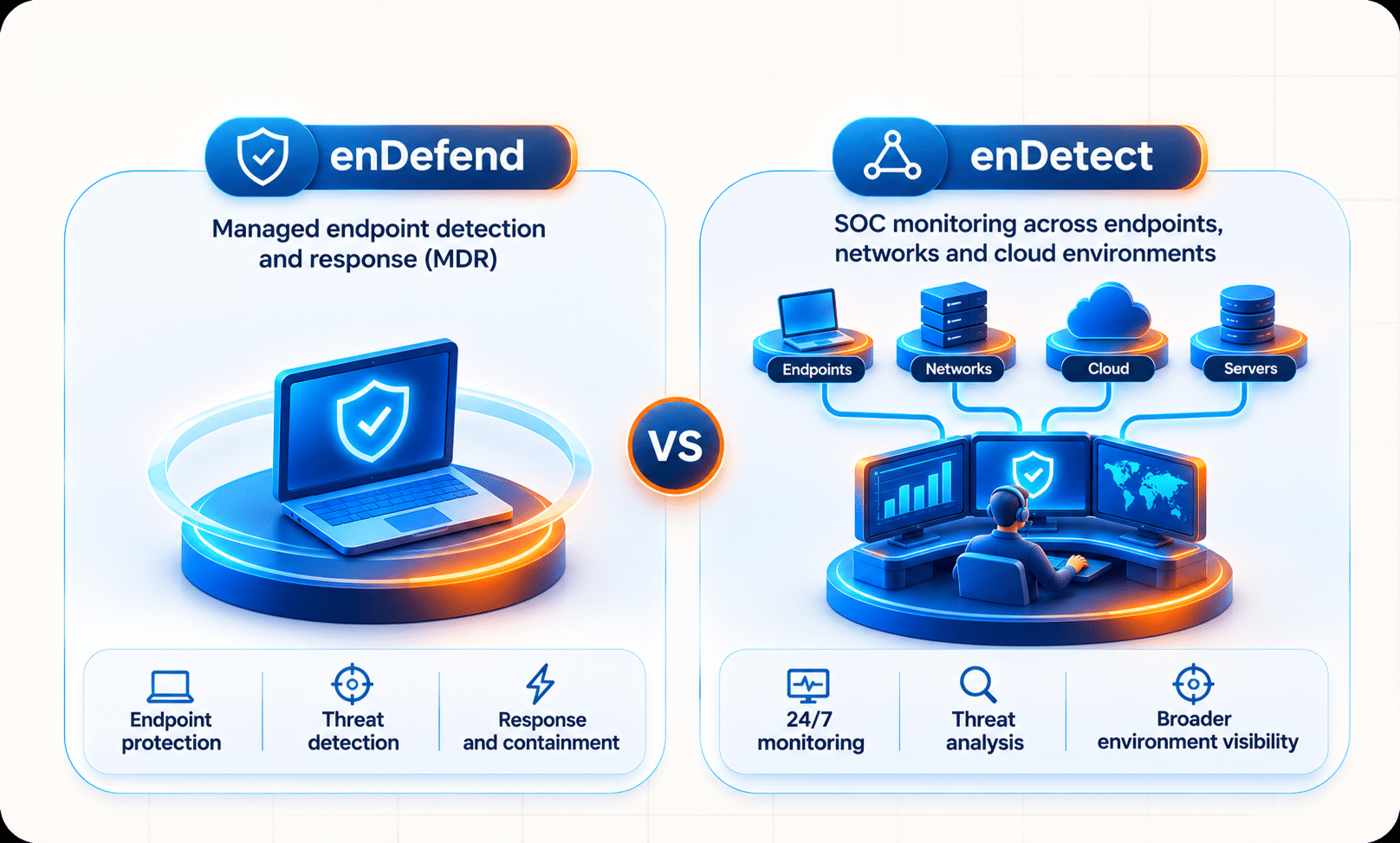
Its enDetect offering delivers SOC as a Service, combining continuous event monitoring, behavioural analytics, threat intelligence and incident correlation.
It describes monitoring across endpoints, network traffic and cloud logs, supported by automated response and SOAR integrations.
Its enDefend offering focuses on managed endpoint detection and response, while its broader MDR services address detection and response across multiple technologies.
These services can be relevant at different stages of a company’s security maturity.
A business with 250 endpoints and relatively straightforward infrastructure may initially prioritise endpoint security and detection.
As the environment expands to include cloud workloads, multiple identity systems and business-critical applications, a broader SOC or MDR service may become appropriate.
Security operations alongside IT administration
EnCyb also provides managed capabilities such as device management, vulnerability management, secure patching, firewall security, backup and cloud operations.
This can matter for companies where the internal IT team is responsible for both preventing cyber incidents and maintaining day-to-day systems.
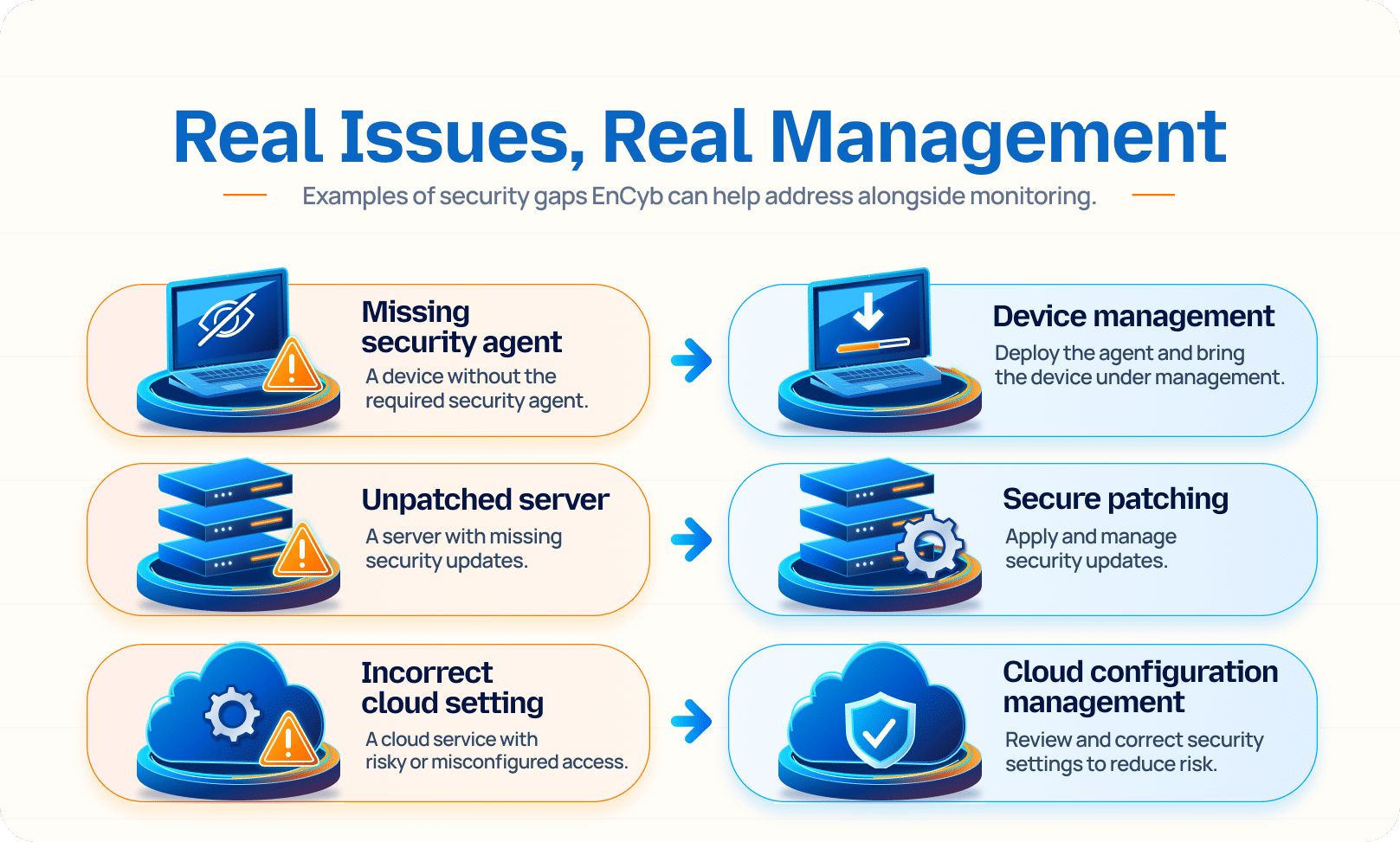
Consider an organisation with 700 endpoints.
An MSSP may identify that some devices are missing security agents, several servers remain unpatched and a cloud security setting has been configured incorrectly.
The organisation then needs someone to address those findings.
EnCyb’s broader portfolio provides options for combining managed detection with related administrative and remediation services.
What should buyers consider?
Offers enDetect for 24/7 SOC monitoring across endpoint, network and cloud signals, and enDefend for managed endpoint detection and response.
enDefend alone is not equivalent to full-environment SOC coverage. Buyers need to choose the combination that covers their actual attack surface.
enDetect supports hybrid and multi-cloud environments, including AWS, Azure and Google Cloud.
Integration claims should be checked against the specific identity systems, SaaS applications, and business-critical log sources used by the customer.
enDetect supports hybrid and multi-cloud environments, including AWS, Azure and Google Cloud.
Integration claims should be checked against the specific identity systems, SaaS applications, and business-critical log sources used by the customer.
The broader portfolio includes managed devices, vulnerability management, secure patching, and backup services.
These are presented as distinct managed capabilities. A SOC or MDR agreement should not be assumed to include all patching, device administration, and backup responsibilities.
Offers automated containment through enDefend/enDetect and separately markets an incident response retainer.
Confirm which investigation, forensic, eradication and recovery activities fall within the regular subscription and when the separate retainer applies.
Offers an additional enSure compliance solution and compliance-oriented SOC reporting.
Compliance automation and advisory capabilities may belong to separate products or engagements rather than the base SOC subscription.
Our assessment
EnCyb is worth considering when a business wants to combine cybersecurity monitoring with broader cloud and endpoint operations.
Its services may be particularly relevant to growing hybrid or cloud-dependent organizations.
The main consideration is determining which responsibilities belong to each managed service and whether consolidating them provides a commercially sensible arrangement.
Website: encyb.com
4. eShield IT Services
Best considered for: UAE businesses seeking managed SOC services with published endpoint-based packages and defined monitoring features.
eShield IT Services is a Dubai-based cybersecurity company offering managed SOC monitoring, penetration testing, vulnerability assessments, incident response and compliance consulting.
Its managed SOC offering is particularly relevant to this comparison because the company publishes service tiers based partly on endpoint count.
For businesses trying to understand how managed security costs change as their environment grows, this is useful initial information.
Where eShield stands out
Endpoint-based SOC packages
eShield’s published managed SOC offering includes three service tiers:
SOC package
Advertised endpoint band
Advertised monthly price
These are provider-published prices, not independently verified contract rates.
For the 200–1,000-endpoint segment, the Standard and Enterprise packages are particularly relevant.
The company advertises 24/7 monitoring across its tiers, with differences in log-source limits, response commitments and advanced capabilities.
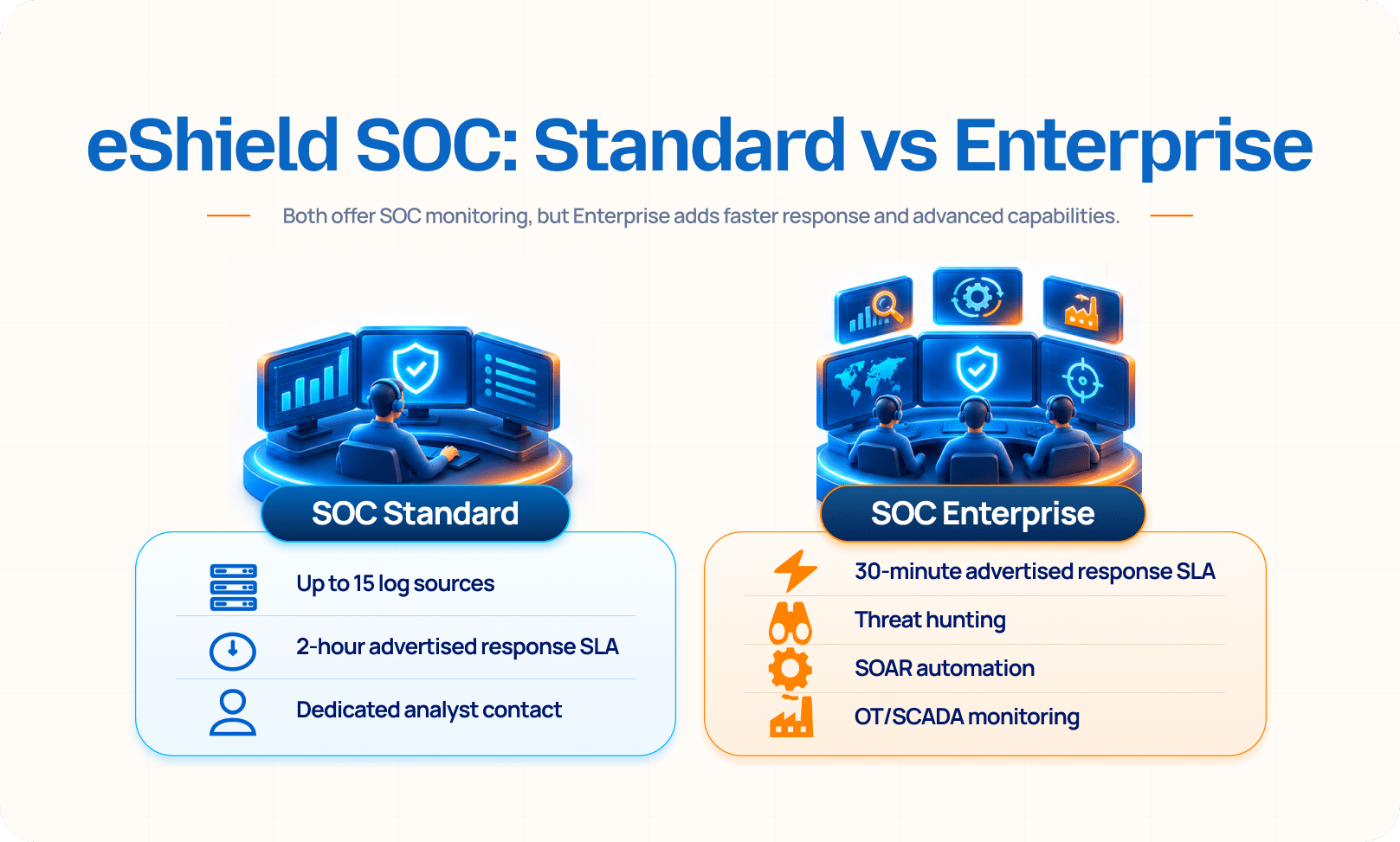
Its Standard offering describes user and entity behaviour analytics, vulnerability management, quarterly tabletop exercises and a dedicated analyst contact.
The Enterprise tier adds capabilities such as threat hunting, SOAR automation, custom detection rules and OT/SCADA monitoring.
This level of published detail can help a buyer prepare a more precise quotation request.
Monitoring and response capabilities
eShield describes a SOC using SIEM technologies such as Microsoft Sentinel or Splunk Enterprise Security, with integrations for endpoint, cloud, firewall and identity telemetry.
Its managed SOC page also describes:
- Continuous security event monitoring
- Alert investigation and false-positive reduction
- Threat intelligence integration
- Vulnerability scanning
- Incident response and containment
- Compliance-oriented reporting
- Log-source health and coverage reporting
The company advertises UAE-based security analysts and UAE data residency.
These are relevant considerations for businesses with contractual or sector-specific requirements concerning the handling of security telemetry.
However, customers should verify the actual hosting region, subprocessors, data transfers, access arrangements and contractual commitments.
What should buyers consider?
Publishes SOC Standard for 100–500 endpoints at AED 12,000–20,000/month and SOC Enterprise for 500+ endpoints at AED 25,000–50,000/month.
Businesses near the 500-endpoint boundary may move into a materially more expensive tier. Confirm the treatment of servers, additional assets and log sources.
Provides 24/7 monitoring, EDR management, firewall management and incident response services.
SOC Standard specifies up to 15 log sources. A business with several offices, cloud environments and security platforms may need additional capacity.
Critical alert triage within 15 minutes and tier-specific response commitments.
The SOC Standard tier advertises a 2-hour response SLA, while Enterprise advertises 30 minutes. Buyers must distinguish initial alert triage from actual response and containment commitments.
Can manage existing SIEM environments, including Microsoft Sentinel, Splunk, QRadar and Elastic, alongside existing security controls.
EDR licences, SIEM usage, log retention and onboarding requirements must be reconciled with the quoted package.
Provides security monitoring evidence and services aligned with frameworks such as ISO 27001, NESA and CBUAE requirements.
Audit evidence and control monitoring support compliance, but do not independently establish that the organisation meets every requirement.
Our assessment
eShield is a relevant option for organizations seeking an endpoint-based starting point for managed SOC procurement.
Its published tiers make service differences and budget expectations more visible than providers that offer only bespoke quotations.
The important next step is validating the advertised commitments, understanding log-source limits, and confirming the specific response activities included in the contracted package.
Website: eshielditservices.com
5. iConnect IT Business Solutions
Best considered for: UAE organisations requiring hands-on management of multiple security controls alongside continuous monitoring and incident response.
iConnect IT Business Solutions is a Dubai-based IT and cybersecurity services provider.
Its managed security portfolio covers security operations, network security, endpoints, identity, email, cloud security, and vulnerability management.
Unlike providers whose managed offering is concentrated primarily around SOC monitoring, iConnect explicitly describes ongoing administration of individual security controls.
Where does iConnect stand out?
Broad security control administration
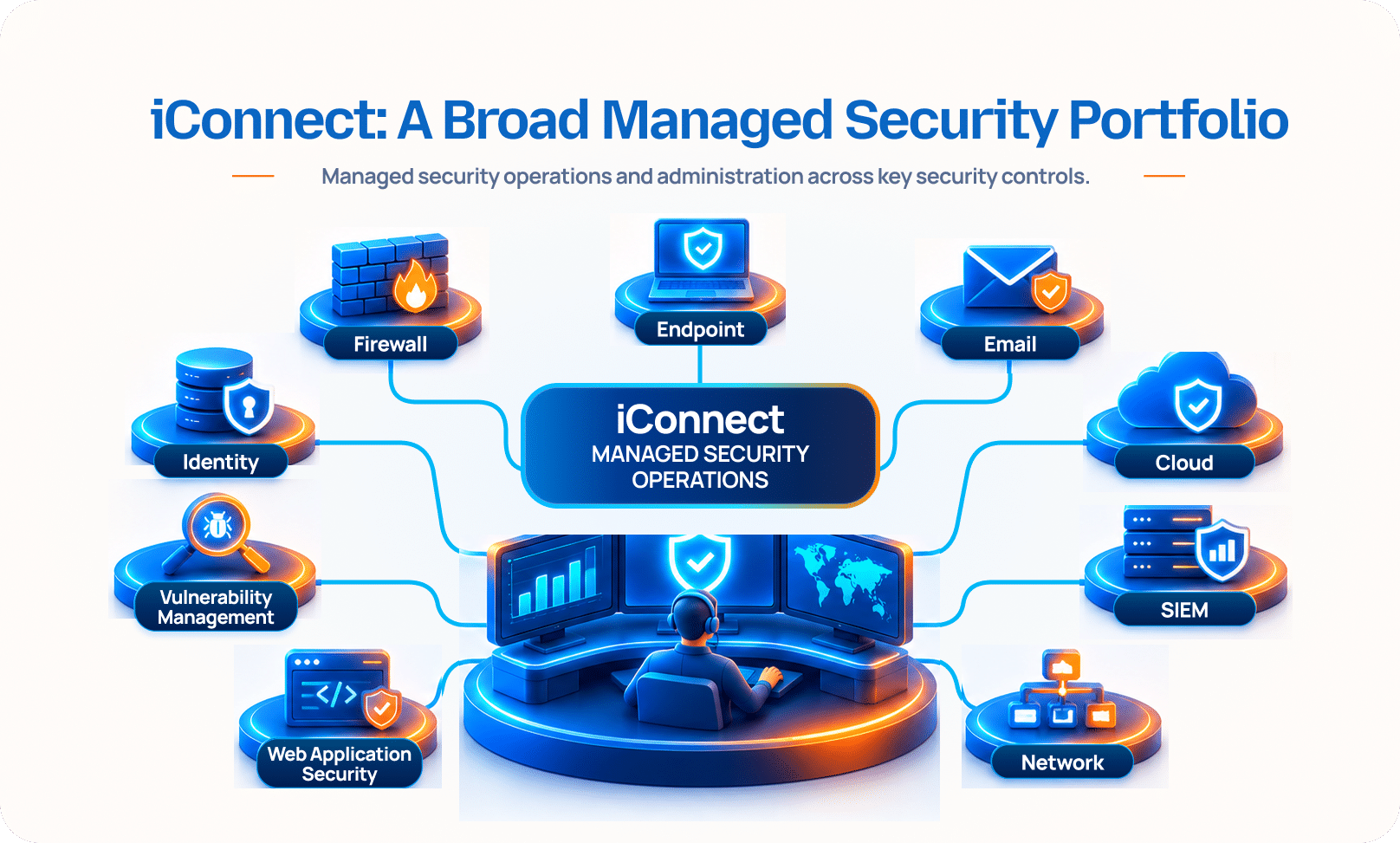
iConnect’s published managed security services include:
- Managed firewall
- Managed endpoint protection
- Managed email security
- Managed SIEM
- Managed identity and access management
- Managed vulnerability management
- Managed web application firewall
- Managed network security
- Managed cloud security
- Managed Detection and Response
This range is relevant for businesses where security administration has become fragmented.
For example, a company may have separate vendors handling endpoint protection, firewall support and Microsoft 365 administration.
When a security issue involves several of those systems, responsibility can become unclear.
An MSSP capable of managing multiple controls under an agreed service arrangement may simplify day-to-day operations and incident coordination.
Security operations and configuration management
iConnect explicitly describes monitoring and management of security controls as part of its managed security services.
Its managed firewall offering includes firewall configuration and continuous management.
Its endpoint and identity offerings similarly address security administration and protection.
The company’s 24/7 SOC is built around the Fortinet Security Fabric, using technologies such as FortiSIEM for correlation and other Fortinet products for endpoint and network detection.
Its published SOC offering also describes detection engineering, automated response workflows, L3 threat hunting and compliance-oriented reporting.
This creates a potentially useful model for businesses already invested in Fortinet security technologies.
What should buyers consider?
Pros
Cons / Trade-offs
Certified Fortinet partner with expertise in FortiGate, FortiSIEM, FortiEDR and FortiManager.
Less straightforward fit for predominantly non-Fortinet environments.
Manages firewall policies, firmware updates, and security configurations.
Multi-vendor firewall management capabilities need confirmation.
FortiSIEM-based monitoring, L3 threat hunting and automated containment.
Automated response depends on supported integrations and pre-approved actions.
In-house Dubai SOC with 24/7 monitoring.
Full MDR onboarding typically takes 2–4 weeks.
Supports CrowdStrike, SentinelOne, Palo Alto Networks and Microsoft tools.
Some integrations may require additional licensing or configuration.
Our assessment
iConnect is a serious option for organizations seeking ongoing management of several security technologies.
Its published service portfolio provides clear examples of traditional MSSP responsibilities, including firewall administration, endpoint protection and identity security.
Businesses with Fortinet-centred environments may find its architecture especially relevant.
Those with heterogeneous security investments should examine compatibility and the commercial implications of the proposed technology model.
Website: iconnectitbs.com
6. Wattlecorp
Best considered for: Organizations seeking a customized managed security arrangement, particularly where security operations, vulnerability management and specialist assessment services need to work together.
Wattlecorp provides cybersecurity consulting, testing and managed security services to organizations in the UAE and other markets.
Its managed security offering includes ongoing security monitoring, SIEM, vulnerability management, managed detection and response, and threat intelligence.
The company also provides SOC design and deployment, with options for on-site or off-site security operations.
Where does Wattlecorp stand out?
Customised security operations
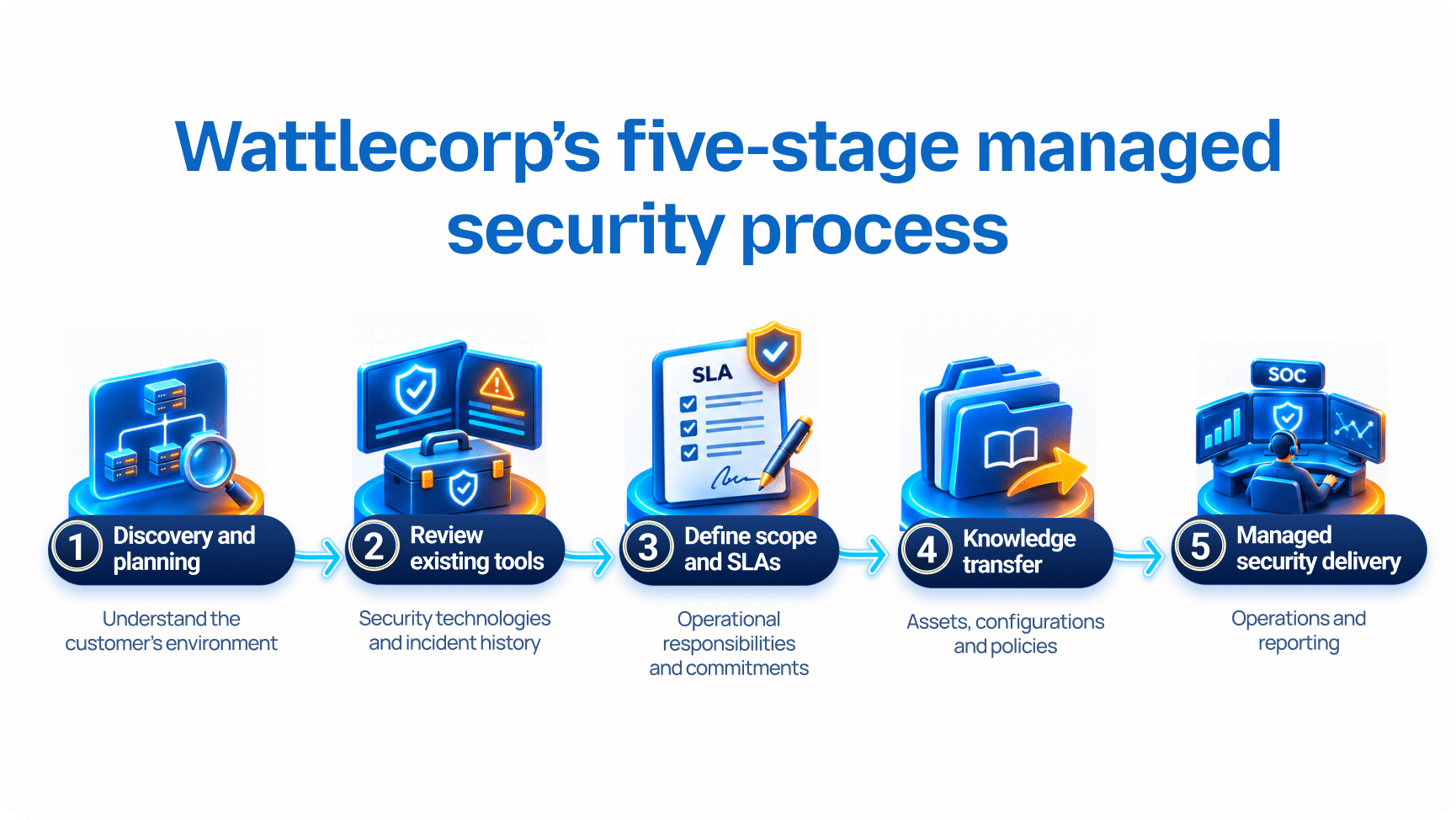
Wattlecorp describes a managed security process built around understanding the customer’s environment before service delivery begins.
Its published methodology includes:
- Discovery and service planning
- Review of existing tools and incident history
- Definition of service responsibilities and SLAs
- Knowledge transfer covering assets, configurations and policies
- Managed security delivery and reporting
This approach may appeal to businesses whose environments do not fit a standardised security subscription.
For example, a company may operate a mixture of legacy servers, modern cloud services and internally developed applications.
Before implementing monitoring, the provider needs to identify which systems contain critical information, which logs are available and which actions can be performed safely.
Wattlecorp’s published approach emphasises this discovery and service-planning process.
SOC and specialist security services
Wattlecorp offers SOC establishment and management, including on-site operations with dedicated personnel.
Its UAE SOC page also highlights expertise in Microsoft Sentinel.
Alongside managed monitoring, the company offers vulnerability assessment, penetration testing, server hardening, cybersecurity advisory and related services.
These capabilities can be relevant when a business needs to assess its security exposure and improve its controls while establishing a managed monitoring function.
However, periodic penetration testing and continuous managed security operations should be treated as separate deliverables unless the agreement explicitly combines them.
What should buyers consider?
Pros
Cons / Trade-offs
Strong Microsoft Sentinel expertise, reportedly used for 80% of its UAE SOC customers.
Expertise with other SIEM platforms needs confirmation.
Offers onsite and offsite SOC with dedicated personnel options.
Dedicated staffing may increase costs.
Provides flexible SLAs and customized security services.
Standard pricing and service packages aren’t publicly available.
Our assessment
Wattlecorp is worth considering for organisations seeking a tailored managed security arrangement alongside security assessment and advisory capabilities.
Its discovery-led approach and on-site/off-site SOC options provide alternatives to fixed security packages.
For businesses with 200–1,000 endpoints, the most important step is obtaining a clear definition of analyst coverage, response responsibilities and the recurring service scope.
Website: wattlecorp.com
7. DTS Solution
Best considered for: Mid-sized businesses with more technically demanding security environments requiring managed detection, threat hunting and security engineering expertise.
DTS Solution is a regional cybersecurity specialist providing security consulting, engineering, operations and response services.
Its portfolio includes managed security operations, network and infrastructure security, cloud security, identity security, vulnerability management and specialist cybersecurity assessments.
Its HAWKEYE offering provides managed 24/7 cyber security operations and MDR.
Where does DTS Solution stand out?
Managed security backed by engineering expertise
HAWKEYE combines continuous threat monitoring with investigation, threat intelligence, threat hunting, and response capabilities.
DTS also provides services involving SOC technology, design, governance, and security engineering.
This can be relevant for businesses whose difficulties extend beyond routine alert investigation.
For example, a company may already operate a SIEM platform but have limited detection coverage.
Logs may be collected without useful correlation rules. Security alerts may generate too many false positives, while critical business systems remain insufficiently monitored.
Improving that environment requires investigation of the security architecture, log-source engineering, detection-rule development and ongoing tuning.
DTS offers services across those disciplines.
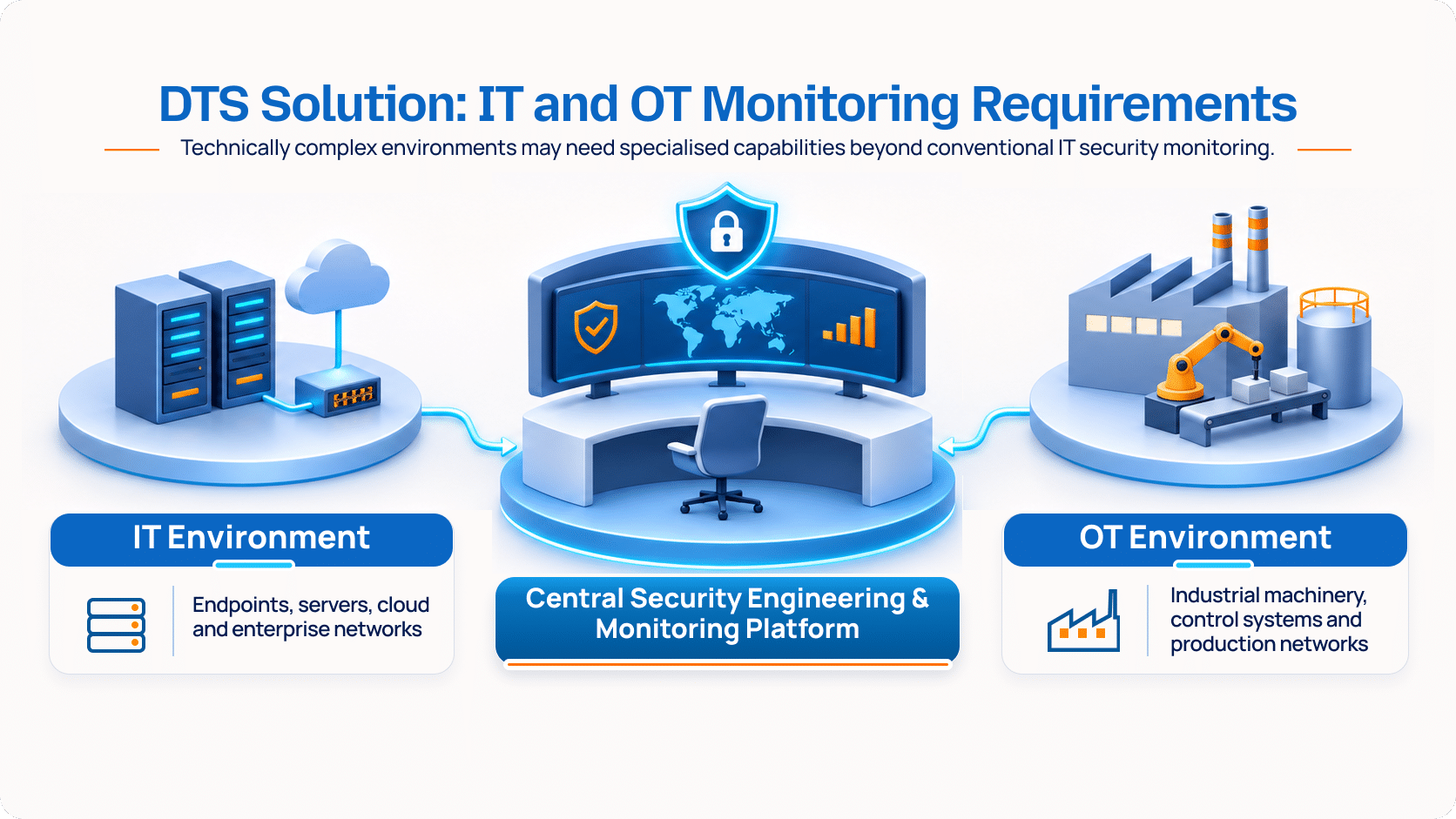
Experience with technically complex environments
DTS also provides services for industrial control systems, operational technology, cloud security and complex enterprise networks.
This may be useful for mid-sized manufacturing, logistics or infrastructure-related organisations.
A company with 400 employee endpoints and a connected production environment could face security requirements that extend beyond conventional endpoint protection.
In those situations, specialist architecture and engineering expertise become important selection criteria.
What should buyers consider?
Pros
Cons / Trade-offs
HAWKEYE provides 24/7 SOC, MDR, threat hunting and SIEM/SOAR capabilities.
Advanced services may require separate engagements.
Strong security engineering across networks, endpoints and cloud.
Implementation and SOC management may be priced separately.
Specialised OT/ICS monitoring and industrial threat detection.
Monthly onsite OT reviews aren’t equivalent to 24/7 monitoring.
Offers remote OT monitoring with logs retained on premises.
Requires additional infrastructure and integration planning.
Suitable for complex IT, OT and hybrid environments.
May offer more specialist capabilities than a standard SMB needs.
Our assessment
DTS is worth evaluating when security monitoring needs to be combined with deeper engineering and specialist security capabilities.
Its HAWKEYE service and wider technical portfolio may suit mid-sized organisations with complex networks, cloud infrastructure or industrial systems.
For a relatively standardised 200–1,000-endpoint environment, buyers should compare the contracted service scope and resource allocation against providers with more SME-focused operating models.
Website: dts-solution.com
What Should a Business With 200–1,000 Endpoints Look for in an MSSP?
Endpoint count provides a starting point for estimating the size of a managed security engagement.
However, it does not accurately describe the organization’s full security workload.
The following considerations help establish what an MSSP agreement should cover.
1. Determine which security responsibilities need to be outsourced
Not every business needs a fully managed security service. Identify whether you need continuous monitoring, incident response, security tool administration, vulnerability management, or a combination of these.
This helps you avoid paying for services your internal team already handles.
2. Evaluatewhat does the managed security model really include
Does the MSSP only monitor alerts, or does it also manage security configurations, update policies and tune detection rules?
A good managed service should make effective use of your security products, not simply react to the alerts they generate.
3. Evaluate what happens during a real security incident
Decide internally and also check with the vendor how an incident is handled. You should be clear on how your vendor responds when a real incident occurs.
Whether they can isolate affected systems, how quickly do they initiate first communication with your team and overall incident response procedures should be clearly documented.
4. Check whether the existing security tools can be retained
Have an initiating conversation with your vendor about current security tools and which ones need to remain depending on your security needs.
Your vendor needs to tell you which tools suit your security purposes, and which ones are just adding to your operational cost without additional value.
5. Compare the complete cost of managed security
Pricing may depend on users, endpoints, log sources or data ingestion.
Compare quotations against the same scope, including licensing, onboarding, monitoring, configuration management, log retention and incident response.
The lowest monthly price may not cover the same responsibilities.
6. Confirm specialist resources and escalation arrangements
24/7 monitoring doesn’t necessarily mean 24/7 access to advanced security specialists.
Check whether L2/L3 investigations, threat hunting and forensic support are included, and whether these resources are shared, dedicated or available at additional cost.
7. Clarify compliance support
An MSSP may help implement and maintain technical controls aligned with frameworks such as ISO 27001 or applicable UAE regulations.
Confirm whether it also provides compliance reporting, audit evidence and advisory support. Managing security controls doesn’t automatically establish regulatory compliance.
Which MSSP Should You Shortlist?
The seven providers have different operating models and areas of emphasis.
Business requirement
Providers worth evaluating
Bundled endpoint, email and identity security
CYB3R, iConnect
Existing security tools requiring ongoing monitoring and configuration management
DC Technologies, iConnect
Managed SOC with publicly advertised endpoint-based pricing
eShield IT Services
Security combined with cloud and device operations
EnCyb, DC Technologies
Customised or on-site SOC arrangements
Wattlecorp
Advanced security engineering and threat hunting
DTS Solution, iConnect
Continuous monitoring with compliance-oriented reporting
DC Technologies, eShield IT Services, EnCyb
These are starting points for evaluation, not independent recommendations based on tested performance.
The appropriate shortlist depends on the organization’s environment, available internal resources and the responsibilities it intends to outsource.
Questions to Ask Before Signing an MSSP Agreement
Before selecting a provider, request a written description of the managed security scope.
The agreement should answer seven questions.
1. Which assets and systems are covered?
Request an inventory of monitored endpoints, servers, cloud platforms, applications, firewalls, identity systems and other relevant log sources.
2. Which security controls will the MSSP actively manage?
Clarify configuration changes, policy maintenance, product administration and security control health checks.
3. What does 24/7 coverage include?
Establish whether human analysts are actively monitoring around the clock and which investigation or response functions are available after hours.
4. What actions can the MSSP take during an incident?
Document pre-approved containment actions, escalation requirements and customer responsibilities.
5. Which services cost extra?
Identify additional charges for specialist investigation, threat hunting, vulnerability management, extended retention, extra integrations and dedicated personnel.
6. How will performance be reported?
Request sample incident reports and monthly service reports covering monitoring coverage, investigation results, response times and outstanding actions.
7. What happens when the contract ends?
Confirm how security telemetry, detection rules, configurations, administrative access and operational documentation will be transferred or removed.
The last question is often overlooked.
Changing MSSPs should not leave an organisation without access to the security information or configurations necessary to maintain its operations.
Final Considerations
Choosing a managed security service provider requires more than comparing the number of cybersecurity products or services listed on a website.
CYB3R provides structured SME packages and differentiated SOC offerings. DC Technologies combines continuous monitoring with security configuration management and compliance-aware technical support.
EnCyb offers managed security alongside cloud and endpoint operations. eShield publishes endpoint-based SOC packages, while iConnect provides broad management of security controls.
Wattlecorp offers customised security operations, and DTS Solution provides managed monitoring alongside deeper engineering and specialist cybersecurity expertise.
These different capabilities can serve different organisational requirements.
For a UAE business managing 200–1,000 endpoints, the most useful approach is to establish which security activities need external ownership, what the provider can manage within the existing environment and which responsibilities will remain internal.
That provides a practical basis for selecting an MSSP that can support the organisation as its security requirements develop.
Looking for Managed Security Services for Your Existing Environment?
DC Technologies works with UAE SMBs that need ongoing security monitoring, incident response and management of their existing security investments.
Our team can review your current security environment, identify the operational responsibilities you need covered and discuss an appropriate managed security arrangement.
FAQs
What is a Managed Security Service Provider?
A Managed Security Service Provider (MSSP) is a company that delivers ongoing cybersecurity operations for another organisation.
Depending on the agreement, services may include security monitoring, control administration, threat investigation, incident response, vulnerability management and reporting.
Do MSSPs need to provide penetration testing?
No. An MSSP can specialise in continuous security operations without offering every form of penetration testing or specialised security assessment.
Penetration testing is generally a point-in-time assessment, while managed security services involve recurring operational responsibilities.
Some providers offer both.
How much do managed security services cost in the UAE?
Pricing depends on the assets, technologies, monitoring requirements and services included.
Some providers publish per-user or endpoint-based packages. Others price according to log volume, monitored systems, service scope or resource allocation.
Buyers should compare the complete service agreement rather than only the headline monthly price.
Can businesses with 200–1,000 endpoints use an MSSP?
Yes. Businesses of this size can benefit from managed security services when their internal teams lack the capacity or expertise to handle continuous monitoring, control management and incident response.
The required service scope depends on infrastructure complexity and business risk, not endpoint count alone.
What is the difference between an MSSP and an MDR provider?
An MSSP can manage a broad range of ongoing security functions, including security tools, configurations and operational processes.
MDR focuses more specifically on continuous threat detection, investigation and response.
An MSSP may offer MDR as part of its wider service portfolio.
Do MSSPs manage existing security products?
Some do. Others use particular security platforms or require specific integrations.
Businesses should confirm whether the provider can work with their existing products and whether the contract includes configuration management, monitoring and response.
Can managed security services help with UAE cybersecurity compliance?
Yes. MSSPs can support technical security controls, monitoring, incident management and recordkeeping relevant to applicable regulations.
However, compliance responsibilities differ by sector and regulatory framework. An MSSP engagement does not automatically establish regulatory compliance.