
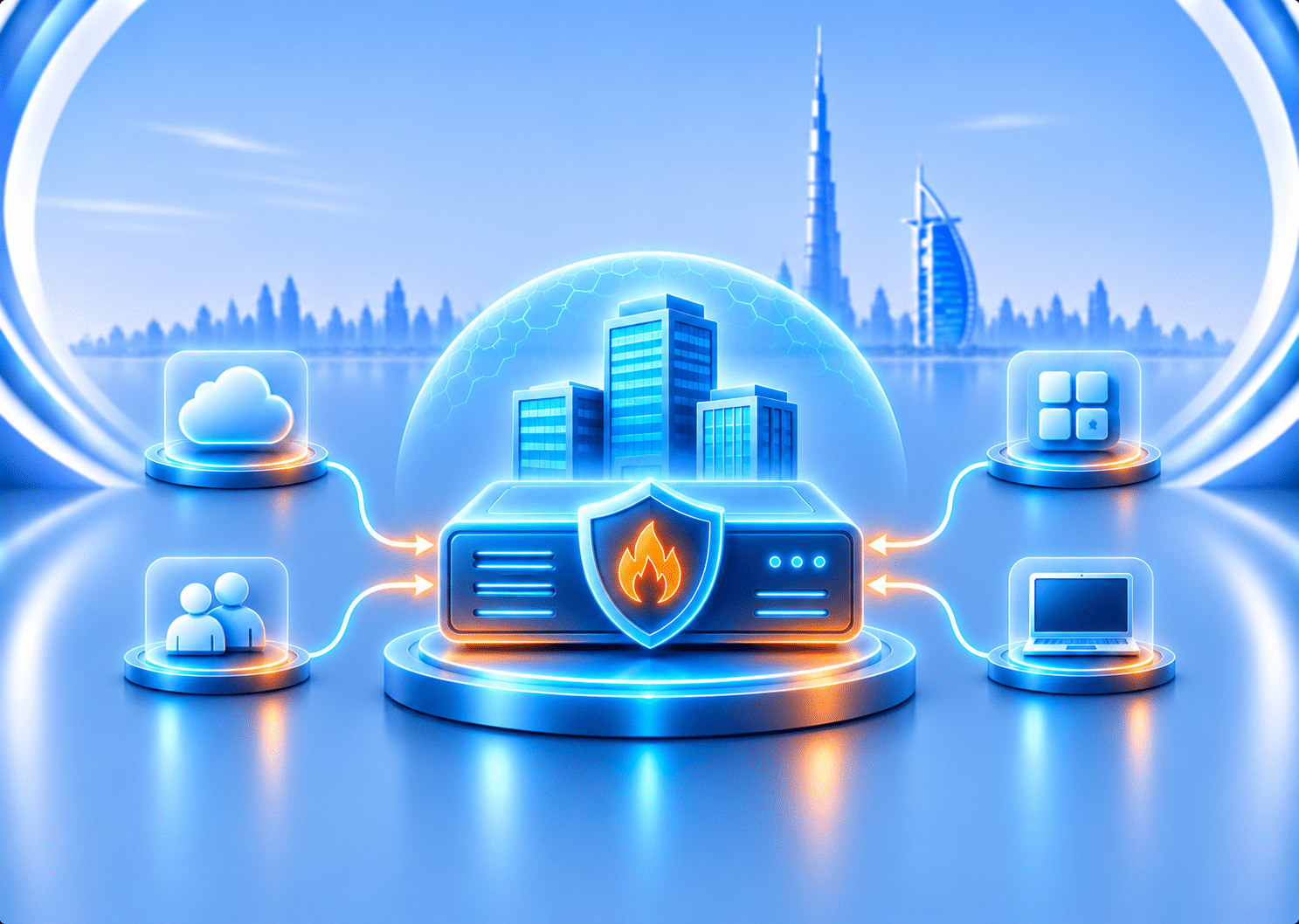
Businesses in the UAE are already exploring a lot of cybersecurity solutions. One product that adds a lot of value to your security posture is next-generation firewalls (NGFW).
While you may have the EDR on every laptop and endpoints, MS 365 security, email protection and a SIEM collecting security alerts, but a NGFW can control the traffic moving between its networks, applications, users and the internet.
Unlike a traditional firewall that primarily filters connections based on IP addresses, ports and protocols, an NGFW can identify applications, inspect supported traffic, detect malicious activity and enforce more granular access policies.
If your company operates across Dubai, Abu Dhabi and other emirates, these capabilities can help protect distributed offices, internal servers, cloud-connected environments, and business-critical applications.
But an NGFW shouldn’t be viewed as a standalone cybersecurity solution.
It works best alongside endpoint protection, identity security, continuous monitoring, and an incident response process. Its effectiveness also depends on proper configuration, inspection policies, security updates, and ongoing management.
For 2027, the question is not a straightforward “which NGFW is better?”.
You need to understand the nuances of different NGFWs in the market, and which fits your environment the best.
The one which gives the right network protection for your environment, integrates with your existing security stack and can be managed effectively over time.
In this guide, we compare four NGFW solutions available through DC Technologies in the UAE: Palo Alto Networks, Fortinet, SonicWall, and Sangfor.
We’ll examine their strengths, limitations and suitability for businesses in the UAE, especially in regulated industries like Financial Services & Healthcare, which need to rigorously protect their systems now more than ever.
Why Should You Go for a Next-Generation Firewall?
1. Blocks Malicious Traffic Before It Reaches Internal Systems
An NGFW can use intrusion prevention, malware detection, DNS security and threat intelligence to identify and block suspicious connections.
For example, it may block a device from connecting to a known malicious server or prevent an exploit attempt against an exposed application.
The protection depends on which inspection services are licensed, enabled, and configured.
2. Controls Which Applications and Users Can Access the Network
Traditional firewall rules may allow traffic over HTTPS without distinguishing the applications using it.
An NGFW can provide more granular application-aware policies.
A business could restrict unauthorized remote-access tools, limit access to administrative applications, or enforce different rules for employees, contractors and guest networks.
Identity-based enforcement depends on the supported integrations and the accuracy of user identification.
3. Limits Attackers Moving Between Internal Systems
Consider a compromised employee laptop attempting to connect to a finance server.
If internal networks are properly segmented and traffic between them passes through the NGFW, policies can restrict unauthorized access.
This reduces opportunities for attackers to move from one part of the environment to another.
Simply purchasing an NGFW doesn’t create effective segmentation. The network architecture and access rules must be designed accordingly.
4. Inspects Suspicious Activity in Supported Encrypted Traffic
Much of today’s business traffic uses HTTPS and other encrypted protocols.
NGFWs can inspect supported encrypted sessions when appropriate decryption policies are enabled.
However, decryption affects performance and introduces privacy, certificate management and operational considerations. Not every connection can or should be decrypted.
5. Sends Network Security Evidence to Your SOC
An NGFW can forward traffic logs, intrusion alerts, policy changes and other security events to a SIEM or managed Security Operations Center.
Those events become more useful when analysts correlate them with EDR, identity, and cloud security data.
For example, an unusual outbound connection might appear more serious when an EDR alert shows suspicious activity on the same device.
Now, let’s look at some of the best available NGFWs in the market that DC Technologies partners with.
Take the analysis as an objective breakdown of strengths and drawbacks of each of the tool and evaluate which one would suit your requirements.
DC Technologies can help you choose one that fits you, and implement and integrate it properly with your current stack.
How We Compare These Next-Generation Firewalls
We compare Palo Alto Networks, Fortinet, SonicWall and Sangfor based on six factors that matter to businesses choosing an NGFW in the UAE.
- Threat Prevention Capabilities: How effectively the NGFW supports intrusion prevention, malware detection, application control and encrypted traffic inspection.
- Network and Infrastructure Fit: How well it supports your network size, multiple offices, cloud connectivity, segmentation and remote access requirements.
- Integration With Existing Security Tools:Whether it works with your EDR, SIEM, identity security and other products without requiring unnecessary replacements.
- Performance and Scalability: How the firewall performs with security inspection enabled, and whether it can support increasing traffic, users and applications.
- Security Management and Compliance: How easily teams can manage policies, monitor threats, maintain configurations and support compliance-related technical controls.
- Total Cost of Ownership: Hardware, security subscriptions, deployment, maintenance and ongoing management costs, rather than just the appliance price.
Again, each of them has strengths and trade-offs depending on the environment.
Our comparison draws on publicly documented vendor capabilities. Actual protection, throughput, and costs depend on the models, licenses and configurations selected.
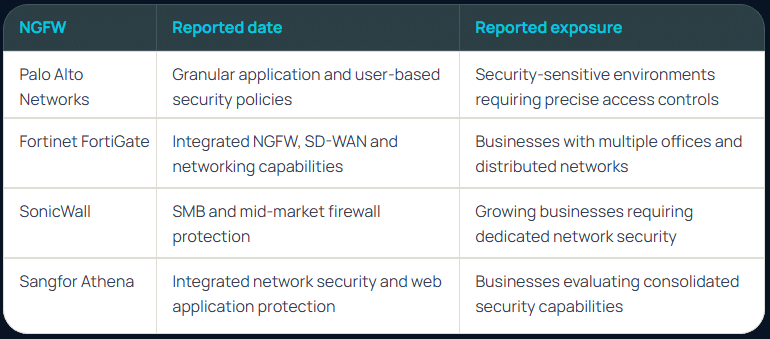
Palo Alto Networks vs Fortinet vs SonicWall vs Sangfor: NGFW Comparison
All four next-generation firewalls provide intrusion prevention, application control, and threat detection. The differences lie in their security capabilities, network integration, management requirements, and costs.
NGFW
Reported date
Reported exposure
Integrated network security and web application protection
Businesses evaluating consolidated security capabilities
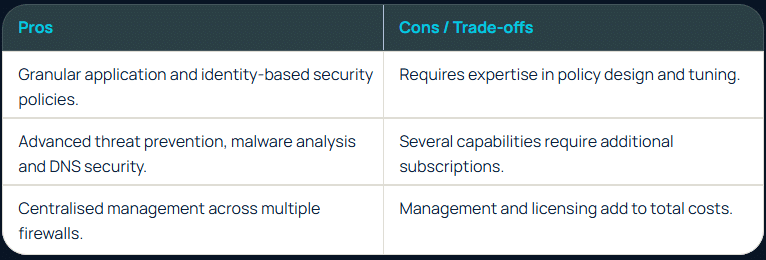
1. Palo Alto Networks NGFW
Best suited for: Businesses requiring advanced threat prevention and granular access control.
Palo Alto Networks uses App-ID and User-ID technologies to identify applications and enforce user-based access policies. Its security services include Advanced Threat Prevention, WildFire malware analysis and DNS Security.
Centralized management through Panorama or Strata Cloud Manager helps businesses maintain consistent policies across locations.
For financial services and healthcare organizations, these capabilities can support tighter control over sensitive applications and internal systems.
Pros
Cons / Trade-offs
2027 consideration: Most standard PA-400 models reach end-of-sale on March 22, 2027. New buyers should evaluate the PA-500 series.
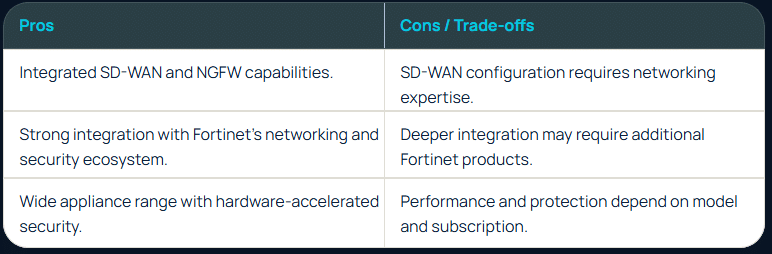
2. Fortinet FortiGate NGFW
Best suited for: Businesses with multiple offices requiring integrated network security and connectivity.
Fortinet combines NGFW protection with secure SD-WAN, allowing businesses to manage network connectivity and security policies together.
Its Fortinet Security Fabric integrates compatible switches, access points and other security products. FortiGuard subscriptions provide additional threat prevention, malware protection and web security capabilities.
This makes FortiGate particularly relevant for businesses managing distributed offices or branch networks across the UAE.
Pros
Cons / Trade-offs
2027 consideration: Compare the full FortiGuard subscription, not just appliance pricing. Security features differ between bundles.
3. SonicWall NGFW
Best suited for: SMBs and mid-sized businesses requiring dedicated firewall security.
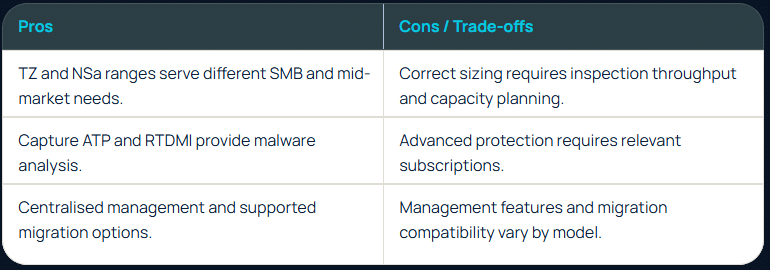
SonicWall offers TZ and NSa firewall ranges for branch offices and growing networks. Its capabilities include intrusion prevention, application control and encrypted traffic inspection.
Capture ATP and Real-Time Deep Memory Inspection (RTDMI) provide additional malware analysis, while Network Security Manager supports centralised administration.
SonicWall is also worth evaluating for businesses upgrading existing firewall deployments.
Pros
Cons / Trade-offs
Centralised management and supported migration options.
Management features and migration compatibility vary by model.
2027 consideration: Evaluate Gen 8 appliances and distinguish managed firewall administration from full SOC monitoring.
4. Sangfor Athena NGFW
Best suited for: Businesses evaluating combined network and web application protection.
Sangfor Athena NGFW combines intrusion prevention, application control, Engine Zero malware detection and Neural-X threat intelligence.
Its notable differentiator is integrated next-generation web application firewall (NGWAF) functionality on supported models.
Sangfor also offers SOC Lite for threat visibility and investigation guidance. These capabilities make it worth considering for businesses protecting internal applications, customer portals and other web-facing systems.
Pros
Cons / Trade-offs
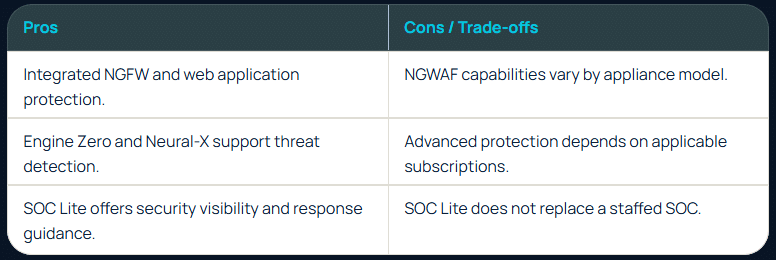
2027 consideration: Verify NGWAF availability on the selected appliance and compatibility with existing EDR, SIEM and security products.
Which NGFW Should Your UAE Business Shortlist?
The choice depends on your security priorities.
Palo Alto Networks is worth evaluating for granular application control.
Fortinet stands out for integrated security and multi-branch networking.
SonicWall offers established firewall options for growing SMBs.
Sangfor brings consolidated network and web application protection capabilities.
All four can be suitable for UAE businesses, including those in financial services and healthcare.
Before purchasing, compare equivalent models with the required security subscriptions, actual inspection throughput, integration requirements, and three-year operating costs.
The best NGFW is the one that fits your network and can be configured, monitored and maintained effectively.
Why NGFWs Matter for Financial Services and Healthcare in the UAE
Financial services and healthcare organizations manage sensitive data and critical systems where a security incident can disrupt operations and expose confidential information.
For Financial Services: NGFWs help restrict unauthorized access to banking applications, payment systems and sensitive customer data. They can detect suspicious network traffic and enforce segmentation between critical financial systems and other networks.
For Healthcare: NGFWs help protect electronic health records (EHRs), medical devices and hospital networks. They can restrict unnecessary connections between systems and help prevent attackers from moving across segmented networks.
In both industries, NGFWs strengthen network security and support compliance-related technical controls. However, their effectiveness depends on proper configuration, continuous monitoring and integration with other security tools.
How to Buy a Next-Generation Firewall in the UAE?
If you’re looking to purchase an NGFW in Dubai, Abu Dhabi or anywhere in the UAE, start by assessing your network size, security requirements, and existing infrastructure.
DC Technologies has been a trusted partner for NGFW solutions from Palo Alto Networks, Fortinet, SonicWall and Sangfor to businesses across the UAE.
Our team can help you:
- Compare suitable NGFW models based on your security requirements.
- Choose the right hardware, licences and security subscriptions.
- Deploy and configure the firewall for your environment.
- Manage security policies, updates and ongoing monitoring.
Whether you’re upgrading an existing firewall or implementing a new one, we can help you select and manage the right solution.
FAQs
What is the difference between a traditional firewall and an NGFW?
Traditional firewalls primarily filter traffic using IP addresses, ports and protocols. Next-generation firewalls add application awareness, intrusion prevention, malware detection and more granular access controls to identify and block suspicious network activity.
Which is the best next-generation firewall for businesses in the UAE?
Palo Alto Networks, Fortinet, SonicWall and Sangfor are all worth evaluating. The right choice depends on your network size, security requirements, existing infrastructure, subscriptions and available management expertise.
How much does a next-generation firewall cost in the UAE?
NGFW pricing depends on the brand, appliance model, throughput, security subscriptions and support requirements. Businesses should compare the total cost of hardware, licensing, deployment and management over three years rather than just the purchase price.
Can an NGFW replace EDR or other endpoint security solutions?
No. An NGFW protects traffic passing through its network enforcement points, while EDR monitors and responds to suspicious activity on individual endpoints. Both provide different layers of protection and work better together.
Do healthcare and financial services companies need an NGFW?
NGFWs can help these organisations protect sensitive systems through network segmentation, application control and threat prevention. They also support technical security controls relevant to compliance, although deploying an NGFW alone does not establish regulatory compliance.
Does an NGFW require continuous monitoring and management?
Yes. Firewall policies need regular reviews, security services require updates, and alerts need investigation. Without proper configuration and ongoing management, even an advanced NGFW may leave significant security gaps.
Where can businesses buy Fortinet, Palo Alto Networks, SonicWall or Sangfor firewalls in the UAE?
DC Technologies supplies NGFW solutions from all four brands to businesses in Dubai, Abu Dhabi and across the UAE. Its team can help with product selection, licensing, deployment, configuration, and ongoing security management.