On November 11, 2026, Dr Shamsheer Vayalil, Chairman of Burjeel Holdings, warned that cyberattacks could disrupt hospital equipment, blood storage and essential communications.
Speaking at the World Congress of Military Medicine in Abu Dhabi, he explained how interconnected medical devices and systems create potential entry points for attackers.
His concern went beyond the theft of patient records. A cyberattack can threaten the systems healthcare workers depend on to deliver treatment.
And UAE healthcare providers have already appeared in several serious ransomware reports.
In June 2025, Gunra claimed to have stolen 450 million records from American Hospital Dubai. That same month, NightSpire allegedly exposed 1.5 TB of data from Al Tadawi Specialty Hospital.
Earlier, Everest had listed global hospital operator Mediclinic Group, which maintains a substantial UAE presence.
Yet public information about these incidents is far from complete. Some reports contain detailed descriptions of allegedly stolen data. Others provide little beyond the attackers’ claims.
This article examines five notable healthcare cyber incidents and ransomware claims linked to the UAE between 2021 and 2025.
Here, we’ll only look at what the available evidence establishes, what still remains unverified, and what healthcare security teams can learn from these attacks.
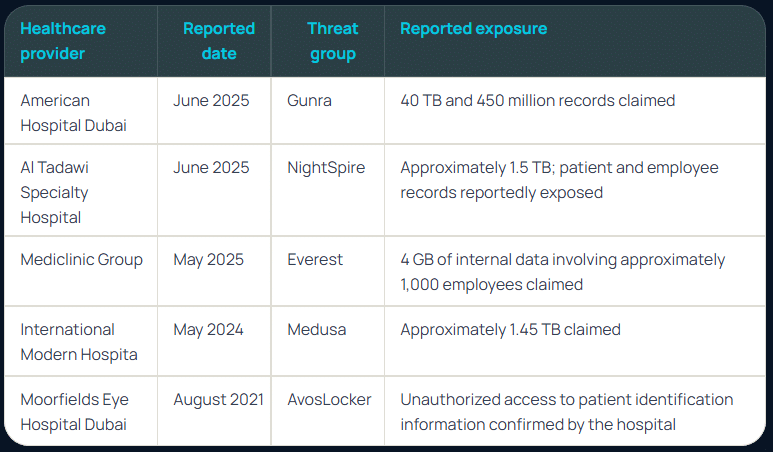
Five Healthcare Cyberattacks in the UAE: At a Glance
Healthcare provider
Reported date
Threat group
Reported exposure
Important notes before you read on:
Ransomware leak-site claims are not independently verified forensic findings.
The Mediclinic claim concerns the international group, and the public evidence does not confirm that its UAE facilities were compromised.
Moorfields is included because it publicly acknowledged an incident, making it an important evidence-based comparison.
1. American Hospital Dubai: Gunra's 450-Million-Record Claim
Reported: June 5, 2025
Threat actor: Gunra
Claimed exposure: 450 million records and 40 TB of data
Status: Publicly reported ransomware claim; precise scope unverified
What happened?
American Hospital Dubai appeared on Gunra’s ransomware leak site in June 2025.
The group claimed it had obtained an extraordinary volume of information from the hospital. The figure of 450 million records subsequently appeared in cybersecurity reporting and legal analysis.
In June 2025, international law firm Beale & Co published an article examining the potential legal and insurance implications of the reported attack.
According to that analysis, the allegedly stolen information included patient demographics, Emirates ID numbers, payment card details, billing records and medical histories.
The kind of information reported to be stolen creates additional cyber and privacy risk for the concerned individuals.
An exposed payment record can create financial fraud risks. An Emirates ID can facilitate identity-related abuse. Medical histories introduce more sensitive confidentiality concerns.
But there is an important limitation: the reported categories and quantities have not been independently verified through a public forensic investigation.
The widely cited figure of 450 million records should not be interpreted as 450 million unique patients. Multiple appointments, documents, and transactions may relate to the same person.
Nor does the available information establish that hospital systems were encrypted or clinical services interrupted.
What about the legal and insurance implications of the attack?
The American Hospital Dubai case illustrates the legal and regulatory exposure healthcare organizations may face after a cyber incident.
However, hospitals operate under overlapping data protection requirements.
Federal Law No. 2 of 2019 regulates the use of information and communication technology in UAE healthcare. It establishes requirements concerning the confidentiality, integrity, and availability of health information.
The broader UAE Personal Data Protection Law, Federal Decree-Law No. 45 of 2021, is also important here. However, Article 2 excludes personal health data already governed by dedicated legislation.
A breach involving patient medical histories, employee identification documents, financial transactions and internal correspondence may require separate analysis of the information involved and the applicable obligations.
And when it comes to the cost of a cyber incident, it definitely extends beyond restoring compromised systems.
Depending on policy terms, cyber insurance may support forensic investigations, legal representation and crisis communications.
Some policies may also cover specified business interruption losses and third-party liabilities.
However, there is no publicly established evidence that American Hospital Dubai had particular insurance coverage or received an insurance payout in connection with the alleged attack.
Security lesson: Detect data extraction, not just ransomware execution
The critical technical question raised by the reported Gunra incident is how a healthcare organization would detect large-scale data collection.
Hospitals maintain patient-related information across clinical applications, billing systems, document repositories, and supporting infrastructure.
A compromised identity or privileged account may have access to several of these locations.
Security monitoring should identify unusual database exports, unexpected access to sensitive repositories, and abnormal outbound data transfers.
2. Al Tadawi Specialty Hospital: NightSpire's Reported Exposure of Patient and Staff Data
Reported: June 8-10, 2025
Threat actor: NightSpire
Reported exposure: Approximately 1.5 TB
Status: Ransomware listing and specialist threat intelligence reporting; full scope unconfirmed
What happened?
In early June 2025, NightSpire listed Dubai-based Al Tadawi Specialty Hospital among its targets.
Healthcare cybersecurity intelligence firm HEAL Security reported approximately 1.5 TB of sensitive data exposure.
CYFIRMA’s June 26, 2025 intelligence report provided a more detailed description of the allegedly compromised information.
It reported that the material included doctors’ and employees’ identification documents, Emirates IDs, passports, visas, photographs, CVs and professional certificates.
CYFIRMA also described the reported exposure of medical records relating to approximately three million patients and information concerning 3,700 hospital VIP members.
The report referred to medical summaries, test results and patient identification details.
These figures and record categories originate from threat intelligence reporting on the alleged leak. They must not be presented as independently confirmed patient counts or forensic findings.
What concerns does this data leak give rise to?
The reported combination of patient information and employee documents creates a lot of different security concerns.
Usually, it’s the medical records that are considered more sensitive information as they can contain information that is in fact highly confidential and should remain so throughout the patients’ treatment.
But employee documents are also important. may include personal identity information and details useful for impersonation.
Internal organizational records can also reveal reporting structures, professional relationships, and administrative workflows.
If authentic, such data could support more convincing phishing and social engineering attempts against hospital staff.
An attacker might use internal organizational details to impersonate a colleague or business partner. That is just a possible downstream risk, but not necessarily an observed risk in this case.
This is why breach investigations must go beyond estimating the amount of data allegedly stolen.
They need to determine the sensitivity of the information, who can be affected, and the potential risks it can entail.
Security lesson: Monitor sensitive data across departments
Patient records are not the only sensitive information in a hospital.
Human resources, finance, procurement, medical administration, and clinical departments may each maintain valuable repositories.
A security team that monitors only electronic health record systems could miss suspicious activity involving employee documents or administrative databases.
The practical controls include monitoring privileged account activity, reviewing unusual access to HR and patient repositories, and detecting bulk exports from systems that rarely produce large transfers.
The objective is to identify when access changes from ordinary business activity into behavior that warrants investigation.
3. Mediclinic Group: Everest's Reported Theft of Employee Information
Reported: May 26, 2025
Threat actor: Everest
Claimed exposure: 4 GB of internal data involving approximately 1,000 employees
Status: Ransomware claim documented by CYFIRMA; UAE facility involvement unconfirmed
What happened?
On May 26, 2025, the Everest ransomware group claimed to have compromised international hospital operator Mediclinic.
According to CYFIRMA’s UAE Cyber Threat Landscape Report, the attackers alleged that they obtained 4 GB of internal information, including personal details relating to approximately 1,000 employees.
Security reporting also described an ultimatum from Everest, giving the organization five days to respond before the attackers threatened to release the information.
Mediclinic operates internationally, including a substantial network of hospitals and clinics in Dubai, Abu Dhabi and Al Ain.
However, the available public reports do not establish which part of the international organization was affected.
There is no verified evidence showing that Mediclinic’s UAE hospitals experienced an operational outage or that their patient records were involved in this specific claim.
That distinction is essential when examining a global healthcare organization through a UAE cybersecurity lens.
Why a relatively small data claim deserves attention
Compared with the volumes claimed in the American Hospital Dubai and Al Tadawi cases, 4 GB appears modest.
But any amount of data stolen can create serious risks for the organization and the individuals involved.
A small set of sensitive employee documents may be more valuable to an attacker than a substantially larger archive of low-value information.
Employee records can contain identity details, organizational relationships and information that helps attackers craft impersonation attempts.
Internal documentation may reveal how an organization operates and which employees hold important roles.
These possibilities are particularly relevant to international healthcare groups that connect multiple hospitals, business units and administrative teams.
The key concern is whether an incident involving one environment could give attackers useful information about others.
Security lesson: Map access across the healthcare group
Large healthcare organizations need to understand where identities and permissions are shared across facilities, business units, and regional operations.
If an account used by a central team becomes compromised, its access permissions determine how far an attacker might be able to move.
Segmentation, privileged access controls, and continuous monitoring help limit that potential.
For security investigations, the priority is to establish which environment is affected and whether access extends beyond it.
4. International Modern Hospital: The Medusa Ransomware Claim
Reported: May 20–21, 2024
Threat actor: Medusa
Claimed exposure: Approximately 1.45 TB
Status: Ransomware listing; clinical disruption not publicly established
What happened?
In May 2024, Medusa listed International Modern Hospital, a multispecialty healthcare provider in Dubai, among its alleged victims.
Cybersecurity company Rewterz reported the claim on May 21, 2024.
Ransomware monitoring records associated with Medusa described approximately 1.45 TB of alleged data exposure.
However, the publicly available information does not identify the confirmed initial access method, compromised clinical applications, or duration of unauthorized access.
It also does not establish that hospital services were interrupted.
The bigger concern for hospitals: Can care continue during an outage?
The International Modern Hospital listing raises an operational question that is not answered by the claimed data volume.
How would a multispecialty hospital function if a critical application suddenly became unavailable?
An interruption to an electronic health record system can affect access to clinical information.
Unavailable laboratory systems can delay in the distribution of the results.
Disruption to imaging infrastructure or its supporting applications may affect diagnostic workflows.
They connect directly to the concern raised by Burjeel Holdings Chairman Dr Shamsheer Vayalil recently (mentioned in the introduction).
In his comments reported by Khaleej Times, he identified connected medical equipment, blood storage, and essential communications as infrastructure that hospitals need to protect against cyber disruption.
His warning also emphasized the need for clear chains of command during emergencies.
Security lesson: Test recovery against clinical requirements
Backups are necessary, but a successful backup does not demonstrate that critical hospital services can be restored quickly enough.
Healthcare recovery planning must identify which systems are essential for treatment and what happens when they become unavailable.
Clinical teams should participate in defining recovery priorities, acceptable downtime, and fallback procedures.
The security team also needs to understand which systems can be safely isolated during an incident, and which require a coordinated clinical decision.
Network segmentation, protected backups and recovery testing can reduce the potential impact of ransomware.
5. Moorfields Eye Hospital Dubai: The 2021 Incident the Hospital Confirmed
Reported: August 2021
Threat actor: AvosLocker claimed responsibility
Claimed exposure: Approximately 60 GB
Status: Unauthorized access confirmed by the hospital; attackers’ complete claims unverified
What happened?
Moorfields Eye Hospital Dubai provides an important contrast to the more recent ransomware listings.
In August 2021, the hospital publicly acknowledged an IT security incident involving some of its Dubai servers.
The hospital confirmed that unauthorized parties had accessed some patient identification information.
At the time of its statement, it said it did not believe patient health records had been compromised.
The hospital contacted affected patients, engaged cybersecurity specialists, and reported taking additional measures to strengthen its network and website security.
Meanwhile, the AvosLocker ransomware group claimed responsibility and alleged that it had obtained approximately 60 GB of information.
The hospital did not publicly confirm the full extent of the attackers’ claims.
Crucially, it also advised patients to continue attending scheduled appointments and said it would continue offering its full range of services.
What makes this case different?
The hospital’s public statement provides information that is missing from several newer ransomware reports.
It distinguishes patient identification information from patient health records.
It describes actions taken after the incident.
It also addresses the availability of clinical services.
These details matter because cybersecurity incidents can affect confidentiality and availability in different ways.
An organization may experience unauthorized access to patient information while maintaining clinical operations.
Conversely, a disruptive attack could interrupt hospital services without a publicly confirmed theft of patient data.
Security lesson: Protect administrative systems and clinical systems
Moorfields illustrates why healthcare providers need protection beyond their primary medical record platforms.
Patient identification information can appear in administrative systems, appointment records and supporting documentation.
Those systems may contain information valuable to criminals even when clinical histories remain unaffected.
Security monitoring should account for these repositories and their access permissions.
Incident response also needs reliable evidence to establish which systems and data categories were affected.
This helps the organization notify affected people accurately, coordinate recovery, and avoid unnecessary operational disruption.
What These Five Cases Reveal About UAE Healthcare Cybersecurity
The incidents differ in age, evidence, and the types of organizations involved.
But three security problems stand out.
1. Continuous monitoring of healthcare environment is crucial
Several of the reported incidents centered on claims of stolen information.
This reflects the importance of data theft in modern ransomware extortion.
Attackers may threaten to disclose information to pressure an organization, whether or not systems were encrypted.
Consequently, successful backups cannot address every ransomware risk.
Hospitals also need to detect unauthorized access, suspicious collection of sensitive files and data transfers that do not match legitimate activity.
2. Healthcare data exposure extends beyond clinical records
The alleged data categories in these cases include patient histories, identification documents, employee information, billing records, and internal documents.
A stolen passport copy or a compromised staff account can also be damaging for the hospital and the individuals concerned.
Hospitals need to identify the information most sensitive to their operations and patients, then ensure appropriate monitoring covers the systems holding it.
3. Clinical resilience requires more than IT disaster recovery
Dr Vayalil’s November 2026 warning is particularly relevant here.
Modern hospitals rely on connected systems, including devices and infrastructure that support treatment, diagnostics and medical supplies.
If a critical communication system or supporting application becomes unavailable, the consequences may extend beyond IT.
That makes cybersecurity a shared operational responsibility involving security teams, infrastructure engineers, clinical engineering, hospital management, and medical staff.
The organization needs to know what can fail, what must remain available, and who makes the containment decisions during an emergency.
The UAE Healthcare Regulatory and Insurance Implications
The five cases also highlight a few issues that often receive less attention than the attack & ransomware itself.
Which cybersecurity regulations apply to UAE healthcare providers?
Federal Law No. 2 of 2019 governs ICT use in the healthcare sector and addresses the protection and availability of health information.
The UAE Personal Data Protection Law also forms part of the wider legal landscape. However, its scope must be assessed carefully, particularly where health data falls under sector-specific legislation.
For healthcare entities in Abu Dhabi, the Department of Health’s AAMEN program and Abu Dhabi Healthcare Information and Cyber Security Standard V2 establish additional sector-specific requirements.
ADHICS V2 covers healthcare information security and includes considerations relevant to connected medical technology, incident management, and resilience.
A healthcare provider should map its requirements to the type of data processed, the relevant licensing authority and its location.
Does cyber insurance cover the full cost of an attack?
Not necessarily.
Cyber insurance can provide valuable financial and professional support after a qualifying incident. But coverage depends on the policy’s terms, limits and exclusions.
Healthcare providers should pay particular attention to forensic response, legal expenses, data breach liabilities, business interruption and dependencies on external service providers.
Hospitals should understand whether their policies address cyber operations associated with conflict, widespread infrastructure disruption, or dependent service failures.
A policy review should happen alongside business continuity planning, so that you know the risks and the consequences early on.
What Should Healthcare Organizations Monitor to Detect Attacks Earlier?
Security area
What should trigger investigation?
What it helps identify
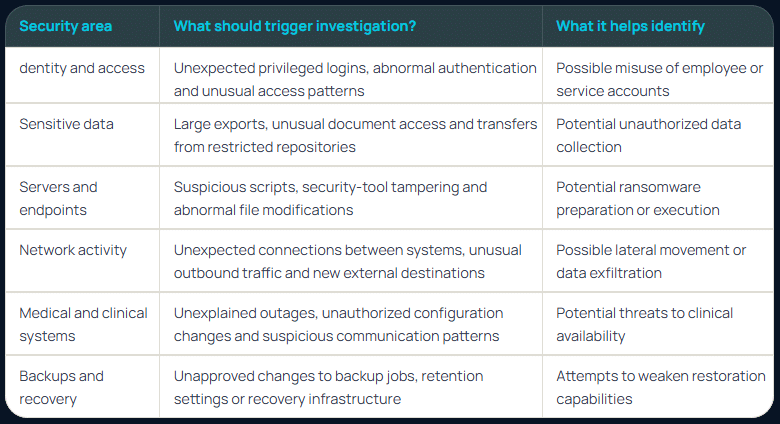
However, collecting alerts is only the beginning.
A hospital’s security team needs a clear process for validating suspicious activity, determining the potential impact and coordinating containment.
For example, isolating a compromised administrative laptop may require an immediate technical decision.
Disconnecting a clinical system that supports active treatment may require consultation with clinical engineering and the medical team.
That difference is fundamental to healthcare incident response.
How Does Managed SOC Help?
A managed Security Operations Center that is native to UAE (Dubai, Abu Dhabi and other emirates) would help healthcare organizations continuously monitor security events, investigate suspicious activity and coordinate responses across their systems.
For hospitals, a useful SOC must do more than identify malware.
It should help establish which accounts are affected, whether sensitive information is being accessed abnormally, how far a threat may have spread, and which response actions can safely be taken.
That requires visibility across identities, endpoints, networks, and relevant applications, combined with a response process that understands clinical dependencies.
At DC Technologies, our managed security services focus on continuous monitoring, investigation and hands-on response through our in-house security operations team.
We work with organizations to improve the time between detecting suspicious activity and acting on a validated threat.
For healthcare providers, that response must also support the continuity of essential services.
Conclusion
The reported healthcare cyberattacks in the UAE reveal more than a threat from ransomware groups.
They expose the complexity of securing patient information across clinical, administrative and operational systems.
The common priority is to detect threats early, establish their actual impact and respond without creating unnecessary risks for patients.
Because in healthcare, cybersecurity has to protect both the information hospitals hold and the services patients depend on.
FAQs
Which hospitals in the UAE have been targeted by ransomware?
American Hospital Dubai, Al Tadawi Specialty Hospital and International Modern Hospital have appeared in ransomware leak-site reports. Moorfields Eye Hospital Dubai publicly acknowledged a cybersecurity incident in August 2021. The scale and impact of the more recent ransomware claims remain unverified.
Was Mediclinic Middle East affected by the Everest ransomware claim?
Everest claimed to have compromised Mediclinic Group in May 2025, allegedly obtaining 4 GB of internal information. Although Mediclinic operates hospitals in the UAE, public reporting does not establish that its Middle East facilities were compromised in that incident.
What are the main cybersecurity risks for UAE hospitals?
Major risks include patient data exposure, employee credential misuse, ransomware, disruptions to clinical applications and attacks affecting connected medical infrastructure. Their severity depends on the systems involved and the hospital’s ability to detect, contain and recover from the incident.
How can healthcare organizations improve ransomware preparedness?
Hospitals should monitor privileged access and sensitive data activity, protect critical systems, segment networks, maintain tested backups and exercise incident response plans. Recovery priorities should reflect clinical dependencies, not only IT requirements.
How can UAE hospitals strengthen their overall security posture?
UAE hospitals should regularly assess security risks across patient records, medical devices, clinical systems and third-party access. Strong access controls, network segmentation, vulnerability management, continuous monitoring, and tested incident response plans help reduce exposure.
Which combination of security tools works best for healthcare organizations?
A typical healthcare security stack includes EDR/XDR, SIEM, IAM, MFA, PAM, network security, vulnerability management, and secure backups. However, the appropriate combination depends on the organization’s clinical systems, medical devices, existing infrastructure, and regulatory requirements.
How can an MSSP like DC Technologies help healthcare organizations in the UAE?
DC Technologies provides 24/7 security monitoring, threat investigation and incident response through its managed SOC and MDR services. This helps hospitals detect and contain threats without building a full in-house security operations team.
How does continuous monitoring help healthcare organizations with compliance?
Continuous monitoring provides security logs, incident records and response evidence that support regulatory audits. It helps UAE healthcare organizations demonstrate ongoing security oversight against applicable requirements, including ADHICS V2 in Abu Dhabi.