
The UAE’s national card switch processed 560.7 million point-of-sale transactions in 2025. Behind those transactions are payment details and customer data that retailers need to keep secure.
That’s what makes retail IT different from a typical office. Retailers handle customer information across in-store checkouts, online orders and payment systems, all while keeping sales moving. They need to protect that data without disrupting everyday operations.
It’s also what makes a breach so costly. A compromised checkout or a stolen staff login can expose customer data, stop payments and leave stores unable to sell, all while customers are waiting to pay.
Protecting this data means knowing where it lives and securing the systems that store and process it. Retailers also need to consider who can access it, including employees, payment providers and maintenance vendors.
For a small IT team, watching all of this around the clock is a challenge in itself. Managed security can help by providing ongoing monitoring and support when threats appear.
In this blog, we look at how retailers can secure POS systems, protect payment transactions, control access and keep operations running when a cyberattack strikes.
TL; DR
- Secure the checkout: Protect POS terminals, card data and online payments while keeping transactions smooth for customers.
- Keep stores running: Detect threats early and have a recovery plan for payment outages, ransomware and disrupted orders.
- Control who gets access: Limit employee and vendor permissions to prevent one compromised account from exposing critical systems.
- Know when to get help: MDR and SOCaaS can help retailers monitor threats around the clock without building a full in-house SOC.
- Get the right protection in place: DC Technologies helps UAE retailers strengthen security with MDR/SOCaaS, EDR/XDR, Bitdefender PHASR, VAPT, firewalls, backup and disaster recovery, and Sangfor HCI.
How Can Retailers Secure Payments and POS Systems?
A payment terminal is a small device with a big responsibility. It sits at the point where a customer’s money changes hands, and if it’s compromised, the problem can extend beyond that one transaction.
For UAE retailers, payment security means protecting both the checkout itself and the systems connected to it.
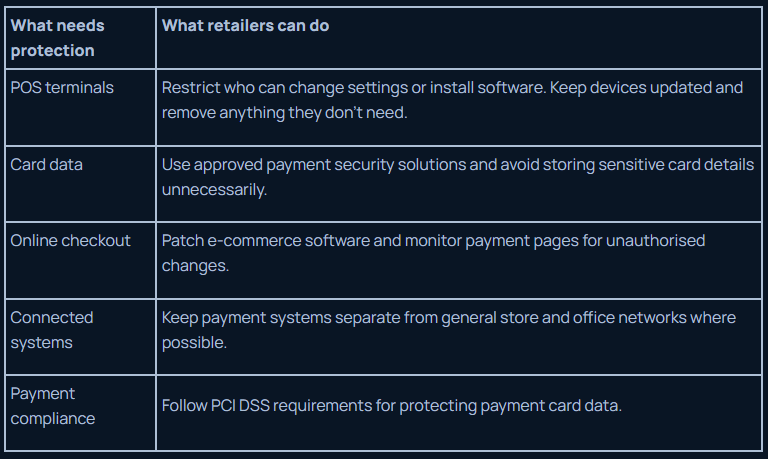
POS terminals
Restrict who can change settings or install software. Keep devices updated and remove anything they don’t need.
Card data
Use approved payment security solutions and avoid storing sensitive card details unnecessarily.
Online checkout
Patch e-commerce software and monitor payment pages for unauthorised changes.
Connected systems
Keep payment systems separate from general store and office networks where possible.
Payment compliance
Follow PCI DSS requirements for protecting payment card data.
There’s another part retailers can easily overlook: who can access these systems. Payment providers and maintenance vendors may need remote access to fix issues, but they shouldn’t have unrestricted access to the wider network. PHASR helps control privileged access, limiting what users can access and reducing the risk of misuse or compromised accounts.
The goal is simple: if one device or account is compromised, the damage shouldn’t spread across the business. Customers should still be able to pay, and the retailer should be able to keep trading.
How Can Retailers Prevent Cyberattacks From Disrupting Operations?
In April 2025, Marks & Spencer paused online orders following a cyber incident. The disruption also affected contactless payments and Click & Collect services. As the incident continued, stores faced product availability issues and delays to normal operations.
For a retailer, one security incident can set off a chain reaction. Orders get stuck, stock becomes harder to manage and store teams have to find workarounds while the IT team investigates.
Here’s how retailers can reduce that risk:
- Spot threats on store devices early. POS terminals, back-office computers and stockroom systems all need protection. Endpoint detection and response (EDR) can help identify suspicious activity before it spreads to other systems.
- Keep stock and order data recoverable. If ransomware affects inventory or order management systems, retailers need clean backups to restore that data. Recovery plans should cover the systems stores rely on to receive stock, fulfil orders and manage deliveries.
- Plan for checkout outages. Decide what store teams should do if payment terminals or the central checkout system becomes unavailable. Have a clear process for escalating the issue and restoring service safely.
- Watch for threats outside business hours. An attack can start overnight and leave stores dealing with the consequences the next morning. Continuous monitoring helps retailers investigate suspicious activity before it becomes a wider operational problem.
The aim is to catch attacks early, limit how far they spread and get essential retail IT systems back up quickly. Because when the systems behind sales stop working, the impact reaches customers, store staff and the supply chain.
How Can Retailers Secure Access Across Stores and Third Parties?
Imagine a POS technician has remote access to fix a payment terminal at one store. If that access also lets them reach other store systems or head-office data, one compromised account could put much more at risk than a single checkout.
Retailers often need employees, payment providers and external IT teams to access their systems. The challenge is making sure each person can reach what they need without opening up the rest of the network.
Here are a few ways to manage that risk:
- Limit employee permissions. Store staff may need sales and inventory systems, but they shouldn’t automatically have access to customer databases or payment infrastructure.
- Secure remote logins. Use multi-factor authentication (MFA) for administrator accounts and remote connections.
- Control vendor access. Give POS technicians and payment providers access only to the systems they need, and remove it when the work is done.
- Review old accounts. Remove access when employees leave or change roles to prevent unused accounts from becoming entry points.
- Monitor privileged activity. Keep track of changes to POS settings and other critical systems.
For retailers looking to tighten control over privileged access, DC Technologies can help implement Bitdefender PHASR. Get in touch with the team to explore how it can help reduce unnecessary access and limit exposure across your IT environment.
The goal is to let store teams and service providers do their jobs without giving a single account access to more than it needs.
When Should Retailers Consider Managed Security Services?
A retailer with five stores and a small IT team has very different retail IT security needs from a large chain with its own security operations center. The right approach depends on the size of the business, the team’s capabilities and how much monitoring is needed.
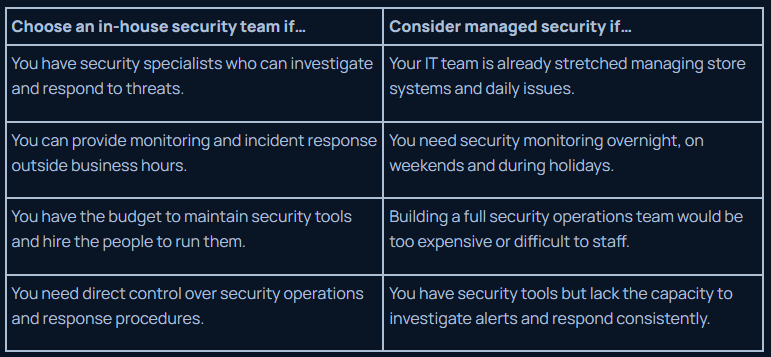
Here’s a simple way to decide:
You have security specialists who can investigate and respond to threats.
Your IT team is already stretched managing store systems and daily issues.
You can provide monitoring and incident response outside business hours.
You need security monitoring overnight, on weekends and during holidays.
You have the budget to maintain security tools and hire the people to run them.
Building a full security operations team would be too expensive or difficult to staff.
You need direct control over security operations and response procedures.
You have security tools but lack the capacity to investigate alerts and respond consistently.
Managed detection and response (MDR) and security operations center as a service (SOCaaS) can provide continuous monitoring and investigation without requiring a retailer to build a full in-house SOC.
Some retailers may also choose a combination of internal IT staff and a managed security provider. The key is to make sure someone is responsible for investigating alerts and responding when a threat appears.
Also Read – In-House vs Managed Security Operations Center: What to Pick?
How DC Technologies Helps UAE Retailers Secure Their IT
Retailers rely on IT systems for everything from checkout and inventory to online orders and customer data. DC Technologies helps UAE businesses protect these systems through security services and infrastructure solutions.
- Vulnerability Assessment and Penetration Testing (VAPT): Find security weaknesses in e-commerce applications and exposed infrastructure.
- Bitdefender PHASR: DC Technologies can implement PHASR to help retailers reduce unnecessary privileges and control access to sensitive systems.
- Backup and Disaster Recovery: Help restore critical systems and data after an incident.
- Sangfor HCI: Consolidate compute, storage and virtualization into one platform, helping simplify the infrastructure behind retail applications and business operations.
Where Should Retailers Start?
Start by reviewing the systems your business depends on most: payment terminals, online checkout, inventory and employee access. Identify where a security issue could interrupt sales, then address the gaps that pose the biggest risk.
DC Technologies helps UAE retailers assess their IT environment and find practical ways to strengthen security and keep operations running. Get in touch to discuss your retail IT security needs.
FAQs
How much does retail IT security cost in the UAE?
The cost depends on the number of stores, POS terminals, endpoints and applications that need protection. It also varies based on whether you need a security assessment, ongoing monitoring or a broader security setup. A review of your existing environment can help establish what you need and where to prioritize spending.
Do retailers need PCI DSS compliance?
Retailers that store, process or transmit payment card data must meet the applicable PCI DSS requirements. Businesses using third-party payment providers may still have responsibilities, depending on how their payment systems are set up.
How can retailers prevent POS hacking?
Restrict administrative access to POS devices, keep software updated, separate payment systems from general networks and monitor endpoints for suspicious activity. Remote access used by payment providers and maintenance teams should also be controlled.
What is the difference between MDR and SOCaaS?
MDR focuses on detecting, investigating and responding to threats. SOCaaS provides access to security operations capabilities through an external provider. The exact scope depends on the service, so retailers should check who monitors alerts, investigates incidents and handles response.
Is managed cybersecurity worth it for small retailers?
It can be, especially when a retailer lacks the staff to monitor security alerts and investigate threats outside business hours. The decision depends on the risks involved, the existing security tools and the level of internal coverage available.
How often should retailers conduct vulnerability assessments?
Retailers should assess their systems regularly and after significant changes, such as launching a new e-commerce platform or making major infrastructure changes. The frequency should reflect the systems’ exposure, risk and applicable compliance requirements.