
Sangfor HCI vs. Nutanix NCI: Which Is Better for UAE SMBs?
If you’re comparing enterprise HCI platforms for your UAE business, Nutanix and Sangfor both cover the core virtualization requirements. The bigger differences show up in how they package features, manage memory, handle security and disaster recovery, and structure licensing.
For an SMB, those differences can have a direct impact on the total cost and complexity of running your infrastructure.
This guide compares Sangfor HCI vs. Nutanix NCI across the areas that matter most when you’re choosing an enterprise virtualization platform.
TL; DR
- Licensing: Nutanix NCI uses Starter, Pro and Ultimate tiers, while Sangfor HCI offers a single software edition with perpetual or subscription licensing.
- Performance: Both support live resource upgrades. Sangfor HCI also offers memory page sharing, which can improve memory utilization across VMs.
- Security & DR: Both platforms support security and disaster recovery, but the capabilities and licensing structure differ. Sangfor HCI includes several of these functions within its platform.
- Workload needs: Both support common enterprise workloads, including databases and GPU-based applications. Specific requirements should be evaluated against each platform's capabilities.
- Local support: DC Technologies is a Sangfor Gold Partner providing deployment and ongoing support for UAE businesses.
Sangfor HCI vs. Nutanix NCI: What's the Main Difference?
At a high level, both platforms consolidate compute, storage and virtualization into a single HCI environment. The key differences become clearer when you compare how each platform handles licensing, memory optimization, security, disaster recovery and ongoing management.
Combines compute, storage and virtualization in one HCI environment
Tiered Starter, Pro and Ultimate editions
Core capabilities are consolidated into one platform
Features are distributed across different licensing tiers
More capabilities are available directly within the Sangfor platform
Some capabilities may require higher tiers or additional products
Designed to provide a broader feature set with a simpler licensing structure
Well suited to organizations that need a mature enterprise ecosystem and tiered options
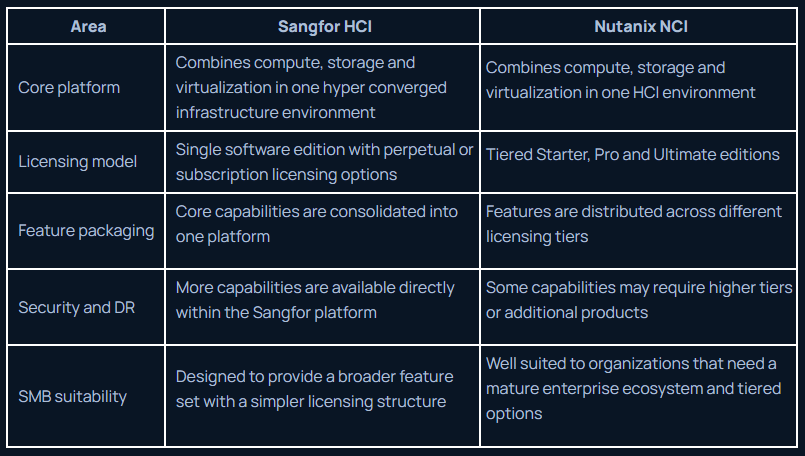
That difference becomes more important when you start adding security, disaster recovery and management capabilities to the environment.
For UAE SMBs, the question isn’t simply which platform has more features.
It’s how much of what you actually need is included from the start.
Licensing: How Much Will You Actually Pay for the Features You Need?
The initial infrastructure purchase is only part of the cost of a hyper converged infrastructure platform.
You also need to consider which features are included in the license you start with and which ones require an upgrade.
Nutanix NCI
Nutanix uses three main licensing tiers:
- Starter
- Pro
- Ultimate
Some capabilities, including features such as erasure coding and deduplication, are gated to higher tiers.
The Starter edition is also capped at 12 nodes per cluster and is designed for on-premise deployments.
This means businesses need to evaluate the tier carefully before comparing headline licensing prices. A lower starting tier may not provide everything you need.
Sangfor HCI
Sangfor HCI starts with a 3-node cluster and uses a single software edition rather than splitting core capabilities across multiple feature tiers.
Businesses can also choose between:
- Perpetual licensing
- Subscription licensing
For an SMB, this gives you more flexibility in how you structure the initial investment and ongoing licensing costs.
The takeaway: Don’t compare the starting price of two HCI platforms in isolation. Compare the cost of getting the full feature set your environment actually needs.
Memory Optimization: How Much Can You Get From Your Existing Hardware?
When multiple virtual machines run on the same physical servers, memory efficiency can directly affect how many workloads your existing hardware can support.
The key difference is how each platform handles duplicate memory usage and resource changes while VMs are running.
Includes memory page sharing, allowing identical memory pages to be shared between VMs. This can reduce duplicate memory usage and allow more workloads to run on the same physical RAM.
Does not offer the same memory page-sharing capability.
Supports live resource upgrades, allowing administrators to add vCPU or vRAM without rebooting running VMs.
Supports live resource upgrades, allowing administrators to add vCPU or vRAM without rebooting running VMs.
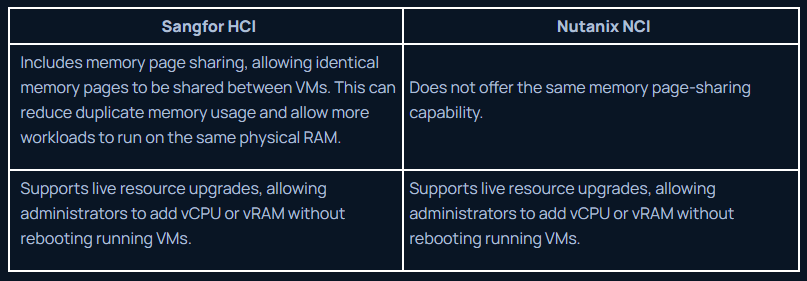
Takeaway: Sangfor HCI can help you get more from existing server hardware by using memory page sharing to reduce duplicate memory usage across VMs. While both platforms support live resource upgrades, Sangfor HCI may have an edge when memory efficiency and workload density are priorities.
Database Deployment: Built-In or Another Tool?
Database workloads often need more than basic VM provisioning.
Sangfor HCI includes built-in deployment wizards for databases such as Oracle and Microsoft SQL, making it easier to configure these environments without relying on a separate database deployment product.
With Nutanix, database deployment automation is handled through a separate product.
That distinction may not matter for every SMB.
But if your environment runs business-critical Oracle or Microsoft SQL workloads, having those deployment capabilities integrated into the HCI platform can reduce the number of tools your infrastructure team needs to manage.
Network and Security: What's Already Built into the Platform?
This is where the two platforms take a noticeably different approach.
Nutanix provides the core infrastructure platform, but businesses may need additional products for certain security requirements.
Sangfor HCI brings more security capabilities directly into the platform through aNET and aSEC.
Here’s how the two compare:
Web Application Firewall
Requires additional tooling
Built in
Cloud security
Requires additional tooling
Built-in cloud security center
Endpoint protection
Not native to NCI
Included natively
Network design
Manual configuration
Visual drag-and-drop design
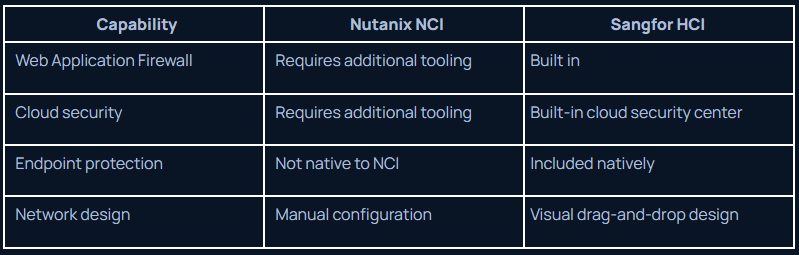
The visual network design capability is particularly useful for teams that don’t want to configure every network relationship manually.
With Sangfor, administrators can visually design the network and deploy it from the same interface.
The bigger consideration, though, is the number of additional security products you need around the HCI platform.
If security is going to be part of the infrastructure stack anyway, having those capabilities integrated can simplify both deployment and management.
Backup and Disaster Recovery: What Happens When Something Goes Wrong?
This is one of the areas where feature comparisons can become misleading.
It’s easy to compare platforms based on whether they “have disaster recovery.”
The more useful question is:
How quickly can you recover, and how much additional infrastructure do you need to make that happen?
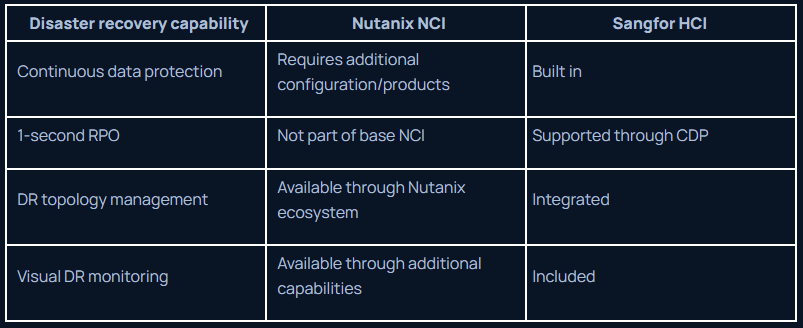
Sangfor HCI includes Continuous Data Protection (CDP), which records changes in real time and supports a recovery point objective of up to one second.
It also provides integrated disaster recovery topology management and visualized DR monitoring through its built-in capabilities.
Nutanix NCI provides disaster recovery capabilities through its broader ecosystem, but not every capability is included in the base NCI tier.
That means businesses comparing the two should look beyond the base license and calculate what is required to achieve their actual recovery objectives.
At a glance
Continuous data protection
Requires additional configuration/products
Built in
1-second RPO
Not part of base NCI
Supported through CDP
DR topology management
Available through Nutanix ecosystem
Integrated
Visual DR monitoring
Available through additional capabilities
Included
For businesses where downtime directly affects revenue or customer operations, this isn’t a minor feature comparison.
It’s part of the business continuity strategy.
USB Devices and Specialized Workloads
Some environments have requirements that don’t show up in standard HCI comparison charts.
For example, businesses may need to connect physical USB devices such as security tokens or specialized hardware to virtual machines.
Sangfor HCI allows a USB token connected to one server to be accessed by a VM across the cluster.
Nutanix does not provide the same physical USB pass-through capability across different cluster nodes.
Both platforms support GPU and heavy graphics workloads, so the choice here depends more on the specific application and hardware configuration.
So, Which Is Better for UAE SMBs?
There isn’t a universal answer.
Nutanix is a mature enterprise HCI platform with a broad ecosystem and extensive capabilities. For larger organizations with complex infrastructure requirements and the budget to build around its licensing model, it can be a strong option.
But UAE SMBs often have a different set of priorities.
They need enterprise-grade virtualization without building a large ecosystem of separate products around it. They also need predictable licensing, practical security capabilities and disaster recovery without continually moving into higher tiers.
That’s where Sangfor HCI can make sense.
Depends on licensing model
Built-in security capabilities
Additional products may be required
Memory page sharing
—
Built-in database deployment wizards
Separate product
Integrated DR capabilities
Broader Nutanix ecosystem
1-second RPO through CDP
Not in base NCI
UAE-based infrastructure support
Depends on partner
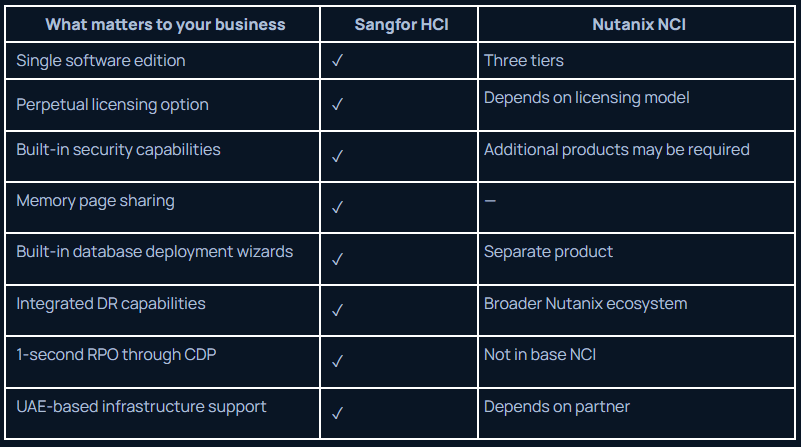
The biggest difference isn’t necessarily which platform has the longer feature list.
It’s how much infrastructure, licensing and vendor management you need to get the environment you actually want.
Conclusion
For UAE businesses, infrastructure decisions increasingly come down to predictability, support and long-term value. Sangfor HCI offers an alternative to traditional multi-tier infrastructure, combining compute, storage and virtualization in a simpler platform.
DC Technologies helps UAE businesses plan, deploy and support Sangfor HCI environments, with local hardware, implementation expertise and ongoing assistance after go-live.
If you are comparing Sangfor with Nutanix or reviewing your current infrastructure, our team can help assess your workloads, recovery objectives and business requirements.
FAQs
What's the difference between Nutanix and Sangfor for small businesses?
Sangfor gives you one edition with everything built in. Nutanix splits key features across three paid tiers, so you pay more to get the same coverage.
Is Sangfor HCI cheaper than Nutanix?
For most small businesses, yes. Nutanix’s base tier doesn’t include DR and security features that come standard with Sangfor, so you’d need a higher paid tier to match it.
Can I switch from Nutanix to Sangfor HCI without downtime?
Migrations can be planned to avoid disruption to your business, though the exact approach depends on your current setup and data volume. DC Technologies handles the assessment and migration plan as part of deployment.
Does Sangfor HCI have the same disaster recovery features as Nutanix?
Sangfor HCI includes disaster recovery natively, with real-time change logging for sub-second recovery points. Nutanix’s disaster recovery tools are split across features that aren’t all included at the base tier, so getting the same depth usually means moving up a tier.
Why do UAE businesses choose Sangfor HCI over Nutanix?
Everything comes built in from day one, no extra tiers to unlock DR or security later.
Share