
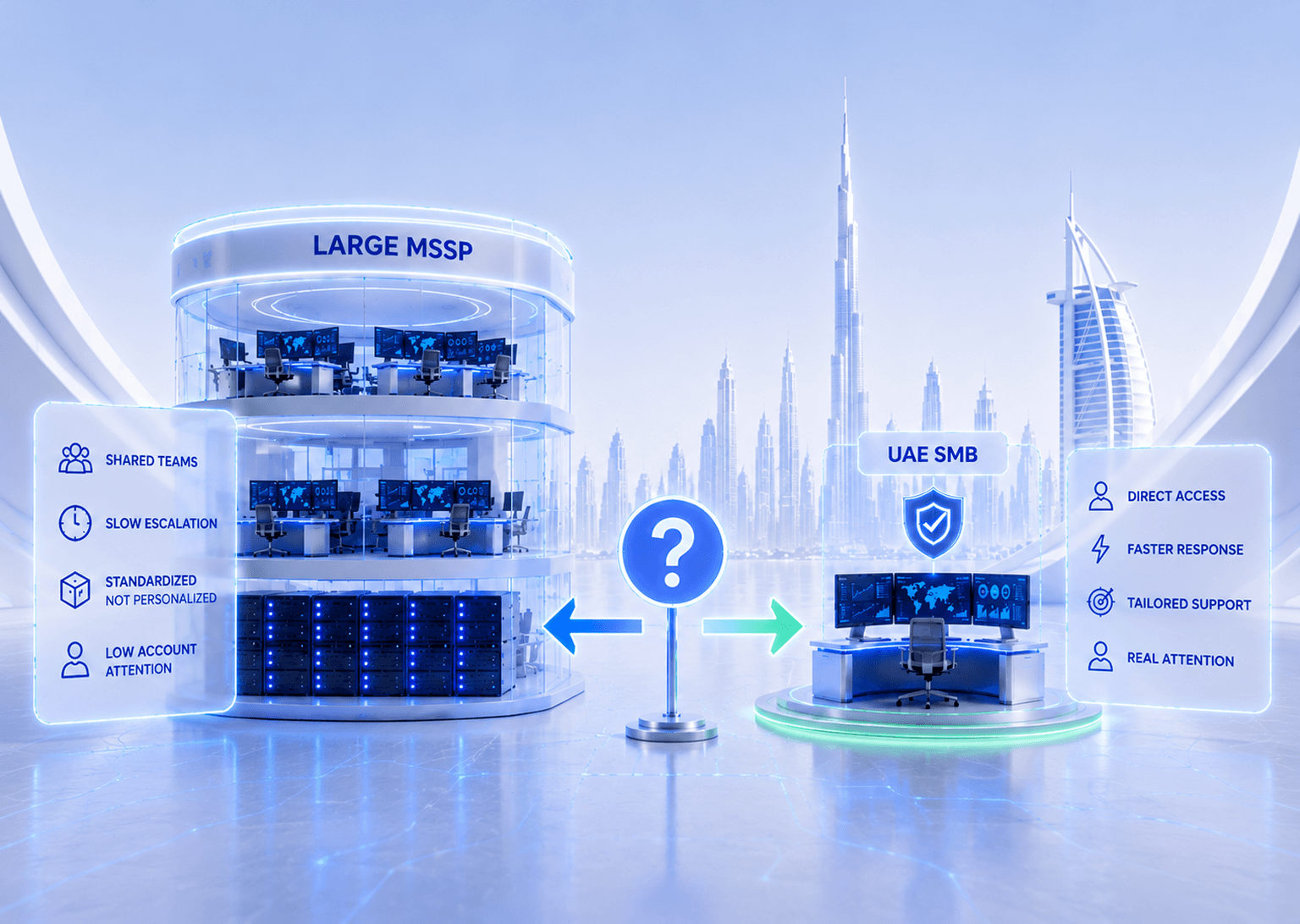
Big MSSPs can be a poor fit for UAE SMBs because the economics of serving smaller accounts often push managed security services in the UAE toward shared teams, ticket queues, and layers of escalation.
The provider may have a massive SOC, but that doesn’t mean your environment gets much attention.
This guide looks at where the large MSSP model creates friction, what UAE SMBs actually need from managed security services, and when a regional managed security services provider may make more sense.
TL; DR
- Scale has trade-offs: Shared teams and standardized processes can limit attention for smaller accounts.
- Context matters: Your provider should understand your environment, tools, and business priorities.
- Response matters: Fast investigation and clear ownership matter more than alert volume.
- Fit beats size: UAE SMBs need security services built around their actual environment.
- DC Technologies: Get 24/7 managed security services with direct, hands-on support.
The Economics Behind a Large MSSP's Delivery Model
A large MSSP has a scale problem.
The bigger it gets, the more it has to standardize how security is delivered. That is how the business stays profitable.
That is not inherently bad, but they can also create problems for smaller businesses.
1. Your security team is probably shared
A large MSSP isn’t putting a dedicated SOC team on your account.
The same analysts may be monitoring dozens of environments.
That keeps costs down. But it also means your business has to compete for attention when several customers have incidents at once.
2. Standardization comes before customization
Large MSSPs rely on standard playbooks, integrations, SLAs, and escalation paths.
That’s efficient.
But if your environment needs something outside the standard process, you may end up navigating the provider’s system instead of getting a service built around yours.
3. More layers can mean more handoffs
L1 investigates, L2 gets involved, L3 may take over.
Then the account team gets updated.
Every layer has a purpose. But every handoff can also mean lost context and slower communication.
During an incident, that’s a problem.
4. The lowest MSSP quote isn't always the lowest cost
Look beyond the monthly fee.
If your team is constantly chasing alerts, explaining context, and coordinating response, you’ve outsourced the monitoring. You haven’t really outsourced the security operation.
The problem isn’t that large MSSPs have too much scale. It’s that scale isn’t the same thing as fit.
What UAE SMBs Actually Need From Managed Security Services
For businesses evaluating managed security services UAE options, the goal is simple: keep the environment monitored, respond quickly, and give the internal IT team someone who can actually take ownership.
1. 24/7 monitoring is the baseline
An MSSP should continuously monitor your environment for suspicious activity, investigate meaningful alerts, and escalate incidents without waiting for your IT team to spot them first.
2. Someone needs to understand your environment
Your provider should know which systems matter, what normal activity looks like, and what could actually disrupt your business.
Otherwise, every incident starts with: “Can you explain what this server does?”
That is wasted time.
3. Your existing security stack should not become the problem
You may already have an EDR, XDR, firewall, SIEM, identity platform, or other security tools in place.
A good managed security services provider should be able to work with what you have where it makes sense.
You shouldn’t have to replace working tools just to fit the provider’s preferred stack.
4. Response matters more than alert volume
Getting 10,000 alerts isn’t impressive.
Knowing which one matters, investigating it quickly, and taking the right action is.
Ask about MTTD, MTTR, escalation, and incident response. These tell you far more about the service than the number of dashboards in the SOC.
5. You need accountability, not another dashboard
Your IT team shouldn’t have to become project managers for the MSSP.
Someone should own the investigation. Someone should communicate what happened. Someone should tell you what needs to happen next.
That’s what you’re paying for.
6. Local context can matter
For UAE businesses, the provider should understand the local operating environment and the regulatory requirements that may apply to your industry.
That doesn’t mean every provider needs to be headquartered in the UAE.
It means your security operation shouldn’t feel completely disconnected from where your business actually operates.
What to Choose: Global MSSP or Regional Managed Security Provider?
There is no universal winner here.
The better choice depends on how complex your environment is, how much support your IT team needs, and how closely you want the provider involved in your security operations.
What matters
Coverage
Smaller teams with more direct customer access
Usually more flexible around your environment
Can involve multiple escalation layers
Often more direct access to the response team
May favor its own technology ecosystem
More likely to work with your existing tools
Varies by provider and region
Stronger understanding of the UAE operating environment
Depends heavily on account size and contract
Often more hands-on for SMB customers
Large, complex, multinational organizations
UAE SMBs that need hands-on security support
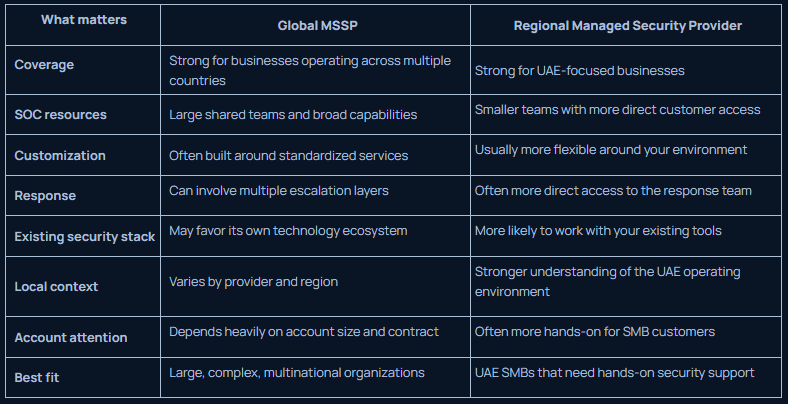
If you’re a UAE SMB with a lean IT team, direct access, practical guidance, and a provider that understands your environment may matter more than the size of the SOC.
That is where DC Technologies takes a different approach.
We combine structured security operations with a more personal, locally informed service model, so you have experienced people who understand your business, your technology, and the realities of operating in the UAE.
Conclusion
Choose an MSSP that can see your environment, respond when it matters, and take ownership without adding more work to your IT team.
If you’re evaluating managed security services in the UAE, DC Technologies can help. Our managed SOC gives UAE businesses 24/7 monitoring, investigation, and response without adding another layer of work for your IT team.
FAQs
Does my small business in UAE really need managed security services?
If your team can’t monitor threats 24/7, managed security services provide continuous monitoring and expert response without building an in-house SOC.
How much does cybersecurity cost for a medium-sized company in Dubai?
What does a managed security service provider actually do?
An MSSP monitors your environment, investigates threats, and helps respond to incidents, giving your IT team security expertise.
Is managed SIEM right for my company?
Managed SIEM makes sense if you have multiple security logs but lack the team to monitor them. Smaller environments may need broader managed security services.
How do I choose the right managed security provider for my business?
Look at monitoring, response times, analyst access, tool compatibility, and incident ownership, not just the SOC’s size.
A large MSSP has a scale problem.
The bigger it gets, the more it has to standardize how security is delivered. That is how the business stays profitable.
That is not inherently bad, but they can also create problems for smaller businesses.